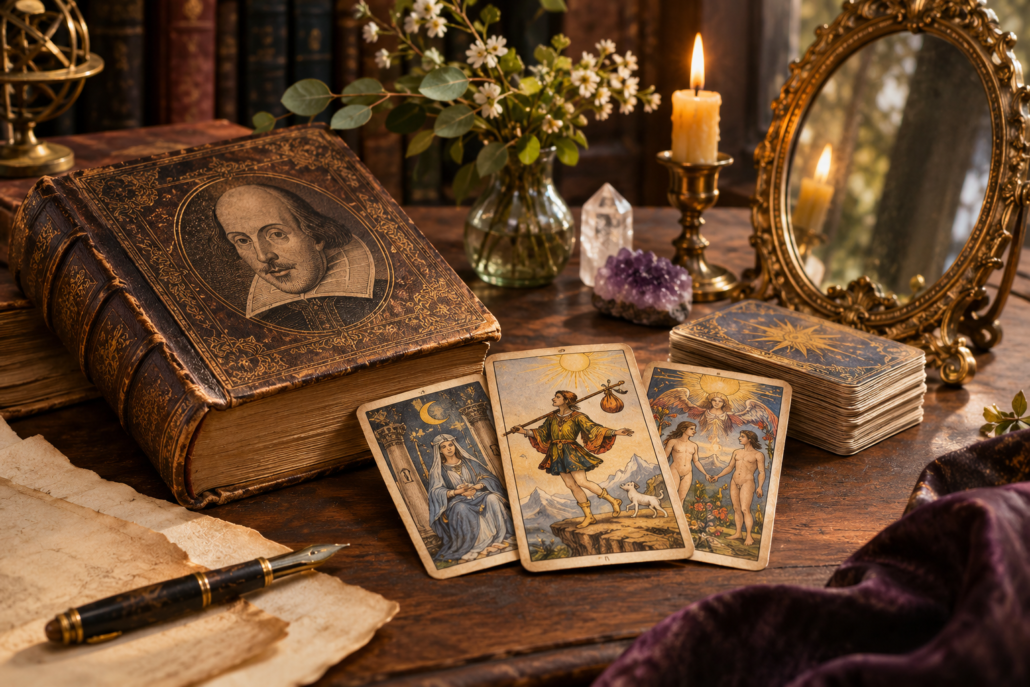
I’ve often thought of Tarot as Shakespeare in a box. Within 78 illustrated cards, we find the entire drama of the human experience. Love and betrayal, courage and cowardice, triumph and tragedy, hope and despair, ambition and temptation, forgiveness and redemption. The good, the bad, and the ugly. All the things that make us wonderfully, imperfectly human are represented in this remarkable little deck of cards.
Shakespeare understood human nature so profoundly that his characters remain recognizable centuries later. We still encounter the jealous Othello, the ambitious Macbeth, the indecisive Hamlet, and the star-crossed lovers Romeo and Juliet. Their circumstances may be different from ours, but their struggles are timeless. We recognize their passions, their fears, their foolishness, and their longing because we have experienced some version of those same emotions ourselves. The costumes and settings may change, but the human drama remains remarkably consistent.
Tarot does something very similar. Rather than telling its stories through dialogue and dramatic scenes, it speaks through pictures, symbols, and archetypes. Every card represents some aspect of the human condition, and together they form a symbolic portrait of our collective experience. Within those 78 cards, we discover not only the stories of others, but reflections of ourselves.
The Archetypes That Connect Us
Swiss psychiatrist Carl Jung introduced the concept of the collective unconscious, a deeper layer of the human psyche containing universal patterns and archetypes that transcend individual experience. These archetypal patterns appear throughout our myths, religions, fairy tales, dreams, and literature. They are the familiar characters, themes, and struggles that humanity has been expressing through storytelling for thousands of years.
The Tarot is rich with these archetypal images. Consider the Fool, standing at the edge of a cliff, ready to begin a journey into the unknown. Who among us hasn’t stood at that same metaphorical precipice, excited by possibility yet uncertain about what lies ahead? Or the Hermit, withdrawing from the noise of the world to seek wisdom within. The Empress embodies the creative and nurturing forces of life, while the Emperor represents structure, responsibility, and authority. The Tower depicts those unsettling moments when everything we believed to be solid suddenly comes crashing down.
Then there’s the Devil, confronting us with our attachments, compulsions, and the invisible chains we sometimes willingly wear. The Star offers renewed hope after hardship, while Death reminds us that transformation often requires releasing something that has outlived its purpose. These aren’t simply characters or situations illustrated on cards. They represent recognizable aspects of our own inner lives, the challenges we encounter, and the possibilities for growth that accompany them.
We have all been the Fool at some point in our lives. We’ve experienced the upheaval of the Tower, sought the solitude of the Hermit, and discovered the quiet courage represented by Strength. Sometimes we embody several archetypes at once, depending on the roles we’re playing and the circumstances we’re navigating. Tarot gives these universal experiences a face, a name, and a story, allowing us to recognize something familiar within ourselves.
Seventy-Eight Cards, Infinite Stories
What fascinates me most about Tarot is the paradox of its limitations and possibilities. There are only 78 cards in a traditional deck, yet the combinations of meaning and personal interpretation seem endless. I believe this reflects something fundamental about humanity itself. The range of our essential emotions and experiences is relatively finite, while the ways we express and experience them are virtually infinite.
Every human being encounters some combination of love, loss, fear, joy, disappointment, desire, conflict, growth, and change. We seek connection, struggle with uncertainty, wrestle with our identities, and search for meaning in our lives. The circumstances surrounding these experiences vary enormously, but the underlying emotional themes remain remarkably consistent. We may have vastly different stories, yet we recognize ourselves in one another because we share the same fundamental human condition.
A woman navigating heartbreak in modern-day America may have very little in common culturally with a woman living thousands of years ago. Their languages, customs, responsibilities, and beliefs might be entirely different. Yet both understand longing, grief, hope, and the desire to be loved. A parent worrying about a child, a young person searching for purpose, or a senior reflecting on a lifetime of choices is participating in an experience shared by countless others throughout human history.
Our customs differ. Our languages differ. Our beliefs and traditions differ. But beneath those distinctions, something profoundly human connects us. The external expressions of life are endlessly diverse, while the essential emotional experiences that define our humanity are shared.
Our stories are different, but the emotional language of being human is universal.
This is what I mean when I say that humanity is contained within the 78 cards of Tarot. I don’t mean that every possible event can be predicted or that human life can be reduced to a collection of illustrated symbols. Rather, the fundamental themes of our existence are represented within the Tarot’s symbolic framework. Every love story, every personal crisis, every moment of courage or uncertainty can find some expression within its archetypal language.
And this brings me to something I find particularly meaningful about the Tarot. For all our apparent differences, we are expressions of one shared humanity. Beneath the identities, beliefs, and circumstances that sometimes divide us, we are connected by experiences that transcend cultures and generations.
We are one.
Tarot as a Mirror of the Soul
I often describe Tarot as a psychospiritual tool because it engages us on several levels of awareness simultaneously. It speaks to the conscious mind, the subconscious mind, and what I call the superconscious, or Higher Self. Through its rich language of pictures and symbols, Tarot creates an opportunity to explore not only what is happening in our lives, but also the deeper beliefs, patterns, and spiritual questions influencing our experience.
On the conscious level, we’re generally aware of our immediate circumstances. We know when a relationship is struggling, when we’re dissatisfied with our work, or when an important decision needs to be made. We recognize our desires and frustrations, even when we’re uncertain about what to do with them. Yet conscious awareness is only part of the story. Beneath the surface, our subconscious holds memories, fears, assumptions, and deeply ingrained patterns that influence how we interpret and respond to the world.
This is where Tarot can become especially revealing. A card may bring our attention to something we’ve been reluctant to acknowledge, or it may illuminate a recurring pattern that has been quietly shaping our choices. The imagery bypasses some of our habitual ways of thinking and invites us to consider possibilities we might otherwise overlook. Sometimes a card confirms something we already know. Other times, it presents an uncomfortable truth or a perspective we hadn’t previously considered.
Beyond the conscious and subconscious, I believe there is another dimension of awareness that connects us with spiritual wisdom. I call this the superconscious, or Higher Self. It is the part of our awareness that seems capable of perceiving beyond the limitations of our everyday thinking, where intuition, inspiration, and a sense of connection with Spirit become accessible. Whether we understand this experience spiritually, psychologically, or through some combination of the two, Tarot provides a meaningful framework for exploring it.
This is why I consider Tarot so much more than a collection of beautiful pictures or a method of predicting the future. A reading can become a conversation between the different levels of our awareness, helping us recognize what we know consciously, uncover what may be hidden subconsciously, and become receptive to the wisdom of our Higher Self. In this way, the cards serve as a mirror, reflecting aspects of ourselves that may be difficult to see through ordinary introspection.
Of course, mirrors don’t always show us what we’d prefer to see. Sometimes they reveal our fears, our contradictions, or the ways we’ve been participating in circumstances that no longer serve us. Yet these moments of recognition can be among the most valuable gifts of a Tarot reading. Greater self-awareness gives us the opportunity to make more conscious choices, rather than continuing to repeat patterns we don’t fully understand.
Tarot is a mirror into our souls, inviting us to see ourselves more clearly.
The Hand of Spirit and the Gift of the Aces
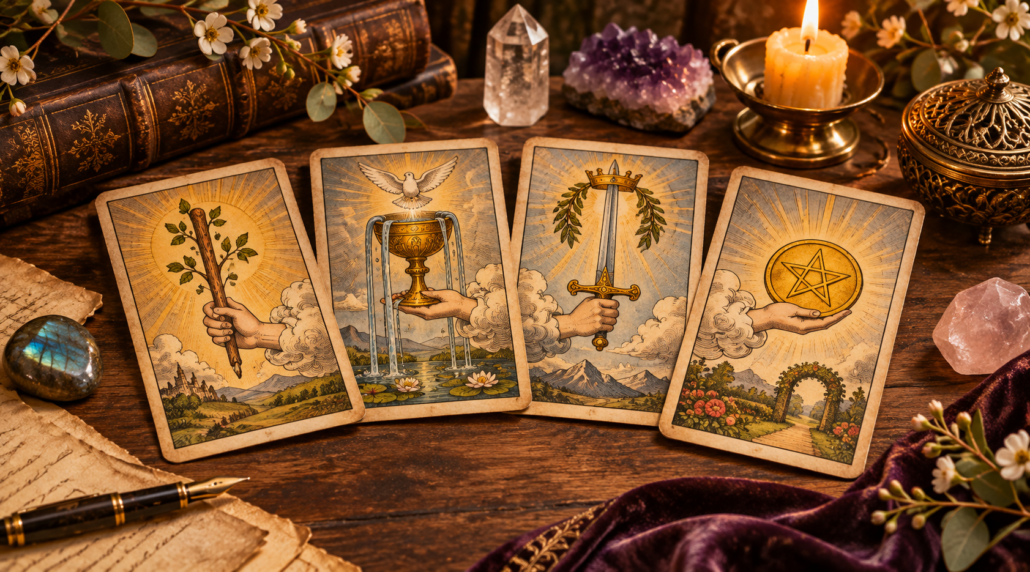
One of my favorite recurring symbols in the Rider-Waite-Smith Tarot is the mysterious hand emerging from a cloud in each of the four Aces. There’s something wonderfully simple and profound about this image. A hand appears from an unseen realm, extending an offering into the visible world. Each Ace represents a beginning, an opportunity, or a seed of potential associated with one of the four suits, yet the symbolism also suggests something deeper about the relationship between spiritual guidance and human choice.
In the Ace of Wands, the hand offers a budding staff, representing inspiration, creative energy, and the spark of new possibility. In the Ace of Cups, it presents an overflowing chalice, inviting us to experience love, compassion, emotional renewal, and spiritual connection. The Ace of Swords offers a crowned sword, symbolizing truth, clarity, discernment, and the power of conscious thought. Finally, the Ace of Pentacles presents a golden coin, representing tangible opportunities, material resources, and the potential to bring our intentions into physical form.
What interests me most is that in each image, the hand is offering something. It isn’t forcing the recipient to accept the gift, nor is it promising that the gift will automatically become something extraordinary. The offering contains potential, but potential requires participation. A seed may hold the possibility of a magnificent tree, but it still needs fertile soil, water, sunlight, and time to grow.
To me, these four Aces beautifully illustrate how Spirit works through a Tarot reading. I believe that when we approach the cards with sincerity and openness, Spirit can guide our attention toward something we need to recognize. We may receive confirmation of something we’ve been feeling, insight into a challenging situation, or an invitation to consider a new direction. Sometimes the message is exactly what we hoped to receive, while other times it reveals something we would rather avoid but genuinely need to understand.
The important distinction is that spiritual guidance doesn’t eliminate our responsibility to participate in our own lives. Spirit may offer the creative spark of the Ace of Wands, but we must develop the idea and take inspired action. Spirit may present the clarity of the Ace of Swords, but we must have the courage to acknowledge and act upon the truth. The Ace of Cups may invite us to open our hearts, but we must be willing to practice compassion and vulnerability. And while the Ace of Pentacles may reveal an opportunity for material growth, it remains our responsibility to cultivate that opportunity through practical effort.
Spirit offers the invitation. The work is ours.
I find this understanding of Tarot deeply empowering because it honors both spiritual connection and personal sovereignty. We can seek guidance, ask questions, and remain open to wisdom beyond our ordinary awareness without surrendering our ability to choose. A Tarot reading isn’t meant to determine our destiny or relieve us of responsibility for our decisions. It is an opportunity to become more conscious participants in the unfolding of our own lives.
The Profound Simplicity and Complexity of Tarot
There’s a beautiful paradox at the heart of Tarot. On one level, it’s astonishingly simple. We have 78 illustrated cards, a question or intention, and a willingness to reflect upon what appears before us. Anyone can begin exploring the cards by looking at their imagery and considering how the scenes, characters, and symbols relate to their personal experiences. We don’t need to memorize every traditional interpretation before we can begin developing a meaningful relationship with Tarot.
Yet beneath that simplicity lies extraordinary complexity. Each card contains layers of psychological, spiritual, historical, and symbolic meaning. The relationship between the Major and Minor Arcana, the four suits, the numbered cards, and the court cards creates an intricate system for exploring the human experience. Even after years of working with Tarot, we can encounter familiar cards that reveal something entirely new to us.
Part of this complexity comes from the fact that we are constantly changing. A card that represented heartbreak during one period of life may later remind us of the wisdom and compassion we developed through that experience. A card that initially seemed frightening may eventually become a symbol of liberation. The Tower, for example, can feel devastating when we’re desperately trying to preserve something familiar, yet the same card may later represent the necessary collapse of beliefs or circumstances that were keeping us confined.
The imagery hasn’t changed, but our relationship to it has. We bring our memories, experiences, beliefs, and evolving awareness to every reading, which means the cards can reflect different layers of meaning as we grow. In this sense, Tarot is not a static collection of definitions to be memorized. It is a living symbolic language through which we can continually explore our developing understanding of ourselves and the world.
Perhaps one of Tarot’s greatest gifts is that it allows us to become both participants in our stories and conscious observers of them. We begin to recognize the archetypal roles we’re playing, the beliefs influencing our choices, and the themes that keep reappearing in our lives. With this awareness comes the possibility of responding differently, releasing old patterns, and making choices that better reflect who we’re becoming.
We Are All Part of the Same Story
When I sit with the Tarot, I’m reminded again and again that beneath our individual personalities and circumstances, we share an extraordinary amount of common ground. We all want to feel safe, to be understood, to experience connection, and to find meaning in our existence. We struggle with uncertainty, wrestle with our fears, celebrate our victories, and attempt to make sense of the losses and disappointments that inevitably accompany being alive.
Shakespeare understood this through the characters and conflicts he created. Jung explored it through the patterns and archetypes of the human psyche. Tarot expresses it through 78 beautifully illustrated cards that have become, for many of us, a deeply personal language of insight and spiritual reflection. Each offers a different doorway into the same essential mystery: what does it mean to be human?
For me, the real magic of Tarot isn’t that the cards somehow contain every answer to every question. It’s that they invite us into a deeper conversation with ourselves, with one another, and with Spirit. They remind us that even our most private struggles belong to a much larger human story. The grief, longing, uncertainty, and hope we sometimes believe are ours alone have been experienced by countless others before us and will be experienced by countless others after us.
There is something both humbling and comforting in this realization. Our personal stories matter enormously, yet we are never as separate as we may imagine. We are connected through the shared experience of being human, even as each of us expresses that humanity in a uniquely individual way.
And perhaps the greatest wisdom Tarot has to offer isn’t about discovering what the future holds. It’s about recognizing who we are, understanding what connects us, and realizing how much freedom we have to shape the stories we’re still writing.
The cards may reveal the archetypes, but we are the ones who bring them to life.
A Tarot Reflection
The next time you sit with your cards, I’d like to invite you to approach them a little differently. Rather than asking what will happen next, consider asking what part of the human story you’re living right now. Which archetype is most active in your experience? What patterns, emotions, or beliefs are asking to be recognized? And what might Spirit be inviting you to understand or embrace?
Choose a card and spend a few moments simply observing its imagery before reaching for the guidebook. Notice the characters, colors, symbols, and relationships within the scene. Pay attention to your emotional response and any memories or associations that arise. Consider how the card might reflect something happening in your life, and what wisdom you might discover by examining that connection more closely.
You may find that the card isn’t telling you something entirely new. Instead, it may be giving language, imagery, and meaning to a truth you’ve been carrying within you all along. Sometimes all we need is a different perspective to recognize what our own wisdom has been quietly trying to tell us.
And that, to me, is the everyday genius and magic of Tarot.






Leave a Reply