One of the biggest misconceptions about psychic ability is that it should feel dramatic. People imagine visions arriving in full color, mysterious voices booming out of nowhere, prophetic dreams that unfold exactly as predicted, or some unmistakable supernatural experience that leaves absolutely no room for doubt. Basically, we expect psychic information to look the way it does in movies.
In real life, it is usually the opposite. Psychic information tends to be quiet, subtle, ordinary, and incredibly easy to dismiss. A thought passes through your mind. Your stomach tightens. Someone’s name suddenly pops into your head. You walk into a room and know there has been tension there, even though everyone is smiling. You have an inexplicable feeling about a decision, only to understand why several days later.
Because these moments are so ordinary, we often explain them away. We call them coincidence, imagination, anxiety, luck, overthinking, or being “too sensitive.” We are waiting for the lightning bolt when intuition is usually more like a tap on the shoulder.
And yet, once we begin paying attention to those taps, something changes. What first seemed ordinary begins to feel extraordinary. You start noticing just how much information is moving around you all the time. You begin seeing patterns, feeling timing, recognizing synchronicities, and understanding that your relationship with life is much more interactive than you realized. Psychic development may be natural, but living consciously with that awareness can still feel wonderfully magical.
We Are Born Receiving Energy
I do not believe we need to become psychic. I believe we are born this way.
Human beings have a funny habit of imagining that we are somehow separate from the rest of nature. We readily accept that animals respond to things we cannot perceive. They sense changes in weather, danger, illness, emotional states, vibration, movement, and subtle changes in their environments. Anyone who has lived with animals has probably watched a dog react to someone before there was an obvious reason, or seen a cat become intensely alert to something the humans in the room had not noticed.
We are animals too.
We are natural transmitters and receivers of energy. We are constantly communicating through our bodies, emotions, voices, expressions, attention, nervous systems, and presence, and we are constantly receiving information from the world around us. Some of that information comes through our familiar physical senses, while other impressions seem to arrive through feeling, knowing, imagery, dreams, instinct, or what we might simply call intuition.
What makes humans unusual may not be that some of us possess intuition while others do not. It may be that we have become exceptionally good at ignoring it.
When we are very young, we have not yet learned which forms of knowing are considered acceptable. Children often speak freely about what they feel, sense, imagine, dream, or simply know. Then the conditioning begins. We are taught to explain ourselves. Where is the proof? How do you know? Be realistic. Don’t be silly. That’s just your imagination. Gradually, many of us learn that what can be measured, demonstrated, and logically defended is more trustworthy than what we directly perceive.
There is also a strange contradiction in the way many of us are raised. We may be taught to distrust our own inner knowing while simultaneously being asked to accept deeply spiritual ideas about invisible beings, divine judgment, prayer, heaven, or forces we cannot physically see or prove. That kind of mixed messaging can be incredibly confusing. We are essentially told that unseen realities are acceptable when they come through an approved belief system, but questionable when they arise through our own direct experience. No wonder so many people grow up second-guessing themselves.
By adulthood, we may have become so practiced at overriding our intuition that we barely notice when it speaks. Psychic development, then, can feel less like acquiring something new and more like reclaiming a way of perceiving that was gradually talked out of us.
There is a quote often attributed to Albert Einstein: “The intuitive mind is a sacred gift and the rational mind is a faithful servant.” The familiar version goes on to say that we have created a society that honors the servant and forgets the gift. Although those exact words have never been reliably traced to Einstein himself, I love the idea behind them because it describes something we do remarkably well. We elevate rational thought while quietly training ourselves not to trust the intuitive information underneath it.
The answer is not to abandon rational thinking. We need the faithful servant. Logic matters. Discernment matters. Physical reality matters. But perhaps the servant was never meant to run the whole house.
Psychic development gives us a way to restore balance. We learn to move through the practical, physical world while also paying attention to the energetic and intuitive dimensions of our experience. We still pay the bills, make dinner, answer emails, go to work, and deal with ordinary life. We simply begin living that ordinary life with more awareness of what is happening beneath the surface.
That is where some of the magic begins.
Psychic Development Is Natural, but It Still Feels Magical
There is a strange paradox in psychic development. On the one hand, there is nothing particularly exotic about it. We are wired for sensitivity, pattern recognition, intuition, emotional attunement, and energetic awareness. On the other hand, when you begin practicing these abilities consciously, life can start to feel much more alive.
Perhaps that is one reason psychic development gets placed on such a pedestal. We imagine psychic awareness as some rare gift reserved for special people because most of us have spent so much of our lives disconnected from it. When we begin using these senses intentionally, the experience feels new even though the capacity itself may be ancient and natural.
There is something deeply satisfying about learning how to collaborate with energy rather than simply being affected by it. Instead of walking into a room and unconsciously absorbing everything, you begin noticing what you are sensing. Instead of dismissing a gut feeling, you become curious about it. Instead of waiting for life to happen and then reacting, you begin paying attention to timing, intuition, synchronicity, and the subtle currents moving through a situation.
You are no longer just receiving information unconsciously. You are directing your awareness.
That distinction matters. Psychic development is not simply becoming more open. It is learning how to work with what you are already receiving. You learn when to open, when to pull back, what to pay attention to, what belongs to you, and what does not. You become an active participant in your energetic life.
There is magic in that, even if it is also completely natural.
The easiest way to understand this is not by looking for some huge mystical experience. It is by looking at your own life. Chances are, intuition has already been showing up in small, familiar ways that you may have overlooked because they did not seem “psychic enough.” Once you begin recognizing those moments for what they are, you start building a relationship with your own awareness instead of waiting for something dramatic to prove that it exists.
With that in mind, here are seven common signs that your intuition may already be working.

1. You Know Who Is Calling or Texting Before You Look
This is one of the simplest intuitive experiences, which is probably why we dismiss it so quickly. Your phone rings, and before you look at the screen, you know who it is. Someone you have not thought about in months suddenly crosses your mind, and later that day, there is a message from them. You begin thinking about a friend, and moments later your phone lights up with their name.
We usually laugh and say, “That’s so weird,” and continue with our day. But these small experiences are worth noticing because psychic information does not always arrive as a dramatic message. Sometimes it arrives as a name, an image, a fleeting thought, or the simple awareness of another person before the physical evidence appears.
The interesting part is not that your friend eventually texted you. It is that some part of you seemed to register the connection first. Once you start noticing experiences like this, they can become delightful little reminders that our connections may be more complex than we normally acknowledge.
2. You Can Feel Someone’s Mood Before They Say Anything
Empaths are especially familiar with this experience. You walk into a room and immediately sense that something is off. Someone tells you they are fine, but you can feel sadness underneath their words. You notice tension between two people who are behaving perfectly politely. You sit down beside someone and suddenly feel anxious, heavy, irritated, or exhausted without understanding why.
Sometimes we absorb another person’s emotional state so quickly that we assume it belongs to us. You can be having a perfectly good afternoon, encounter someone who is overwhelmed, and ten minutes later wonder why you suddenly feel terrible.
This is where sensitivity without discernment becomes exhausting. Psychic development is not simply about opening yourself to more information. For an empath, it is often about learning to identify what you are already receiving. What was I feeling before I walked into this room? When did this emotion begin? Does this feeling actually belong to me?
As you become more skilled, sensitivity can begin to feel less like a burden and more like a finely tuned instrument. You are still feeling deeply, but you are no longer being carried around by every energetic current you encounter.
3. You Get Strong Gut Feelings You Cannot Explain
There is a reason we use the phrase “gut feeling.” Sometimes your body knows something before your rational mind has enough information to understand it. You meet someone who seems perfectly pleasant, but something inside you tightens. You are about to agree to an opportunity that looks good on paper, but your entire body says no. Another choice makes very little logical sense, yet you feel unexpectedly calm and clear when you consider it.
The rational mind hates this because it wants reasons. It wants evidence and explanations before making a decision. Intuitive information often arrives before those explanations are available.
Of course, every uncomfortable feeling is not automatically intuition. Anxiety, previous experiences, fear, conditioning, and nervous-system responses can create powerful physical sensations too. Learning the difference is part of discernment. The more you observe your reactions over time, the more familiar your own intuitive language becomes.
Eventually, something wonderful happens. You begin recognizing your own energetic vocabulary. You know what your yes feels like. You know your no. You begin noticing the difference between fear and intuitive caution, between excitement and energetic alignment, between mental noise and quiet knowing.
4. You Think About Something Right Before It Happens
Maybe an old friend suddenly comes to mind, and you run into them later that afternoon. You inexplicably think about a particular place, and someone invites you there the following day. A strange topic appears in your mind and then shows up repeatedly in conversations, podcasts, books, or emails.
These experiences can feel so insignificant that we barely register them. Yet this is exactly how much intuitive information enters our awareness: disguised as an ordinary thought.
One of the fascinating things about developing intuition is learning to notice the difference between a thought you deliberately constructed and one that simply arrived. Intuitive thoughts are often surprisingly brief and neutral. There may be no reasoning leading up to them. They simply appear, and because they sound like your own internal voice, you assume you made them up.
When you start tracking these moments, life becomes much more interesting. You notice threads connecting experiences. You begin wondering whether some thoughts are less random than you once assumed. The world starts feeling a little more conversational.
5. Your Dreams Sometimes Feel Different From Ordinary Dreams
Most dreams are probably exactly what they seem to be: our minds processing memories, emotions, experiences, worries, and whatever bizarre collection of information we accumulated during the day. But occasionally, there is a dream that feels different.
It may be unusually clear or coherent. You remember it long after waking. You dream about someone and later discover that something significant was happening with them. You dream about a place or event that eventually feels strangely familiar when you encounter it in waking life. Sometimes the dream is not predictive at all, but carries an unmistakable sense that there is information in it worth paying attention to.
If this happens to you, writing your dreams down can be surprisingly useful. Intuitive patterns are easy to dismiss when you are relying on memory alone. When you have a record, you can look back and begin identifying which dreams were simply dreams and which ones seemed to carry something more.
There is a wonderful sense of wonder that can emerge from this kind of observation. You do not have to force meaning onto every dream or turn every symbol into a prophecy. You simply become more curious about the ways your deeper awareness may be communicating with you.
6. You Suddenly Know Something Without Knowing How You Know It
This may be one of the least dramatic and most fascinating forms of intuition because nothing particularly exciting happens. There is no vision, no voice, and sometimes not even a physical sensation. You simply know something.
You know what someone is going to say before they say it. You suddenly understand what is really happening in a situation. You know which direction you need to go or which decision you need to make without being able to explain the reasoning behind it. Later, information arrives that confirms what you somehow already knew.
This experience is sometimes called claircognizance, or clear knowing, and it is especially easy to dismiss because it sounds exactly like your own thoughts. Many people expect psychic information to feel foreign, supernatural, or somehow separate from themselves. Instead, it may arrive in the same voice you have been hearing inside your head your entire life.
Learning to work with this kind of knowing can feel magical because you begin discovering that your awareness extends beyond what your rational mind can immediately explain. You are not abandoning logic. You are simply allowing another form of intelligence into the conversation.
7. You Have Had Moments When You Knew Something Was Wrong Before You Had Proof
Most people can look back on certain experiences in their lives and say, “I knew.”
You knew the relationship had changed before the conversation happened. You knew something at work was not right before the announcement arrived. You knew someone was withholding something. You knew the situation was not going to work, even though everyone around you insisted that everything looked fine. At the time, you may have talked yourself out of it because you did not have enough evidence.
Then the evidence arrived.
This is one of the frustrating things about intuition: confirmation often comes later. We are accustomed to believing that we should receive evidence first and form a conclusion second. Intuition sometimes reverses the order. The information arrives first, and the explanation catches up later.
That is why so many intuitive experiences are recognized in hindsight. We remember the feeling we dismissed, the thought we ignored, or the hesitation we overrode, and realize that some part of us already knew. Psychic development helps close that gap between receiving information and trusting ourselves enough to acknowledge it.
Psychic Information Is Usually Quieter Than You Expect
This is where many people get stuck with psychic development. They are waiting for their intuition to become louder when the real invitation may be to become quieter themselves.
The thinking mind is noisy. It analyzes, debates, rehearses conversations, predicts disasters, questions everything, searches for certainty, and comes back ten minutes later to reconsider the entire thing. Intuition often behaves very differently. It may offer one simple impression and then disappear beneath all that mental activity.
This is also why developing psychic ability can involve unlearning. We have spent years strengthening our rational minds because that is what school, work, and much of our culture reward. We have practiced explaining, proving, analyzing, and defending what we know. Most of us have spent considerably less time practicing stillness, receptivity, observation, and trust.
We did not necessarily lose our psychic senses. We stopped listening to them.
When we begin listening again, life can regain some of the wonder we often lose as adults. Coincidences become curious. Dreams become interesting. Energy becomes something we can notice rather than something that simply knocks us around. We begin experiencing ourselves as part of a living, responsive world rather than as isolated observers moving through it.
A Psychic Lifestyle Is About Living in Both Worlds
For me, one of the most beautiful things about psychic development is that it does not require us to choose between spiritual life and physical life. In fact, healthy psychic development asks us to live more fully in both.
We are here in physical bodies, living physical lives. We have relationships, responsibilities, work, money, homes, errands, bodies, emotions, and very real decisions to make. Psychic awareness does not make those things less important. Ideally, it helps us engage with them more consciously.
At the same time, there is another layer of experience available to us. There is intuition, energy, synchronicity, inner knowing, symbolism, dreams, spiritual connection, and the mysterious way certain moments seem to arrive with meaning. When we make room for that dimension of life, the physical world does not disappear. It becomes richer.
A psychic lifestyle is not about floating above ordinary life or trying to turn every experience into a mystical event. It is about allowing the visible and invisible aspects of life to inform each other. You can be deeply grounded and deeply intuitive at the same time. You can use common sense and listen to your gut. You can plan carefully and still leave room for synchronicity. You can enjoy the practical realities of being human while remaining open to mystery.
That balance is where the real magic lives.
You Don’t Have to Become Psychic
If you are already sensing the energy in a room, receiving gut feelings, dreaming about things before they happen, thinking about someone before they contact you, or occasionally knowing something you cannot logically explain, there may be much more happening beneath the surface than you realize.
You do not have to turn yourself into a psychic person. You are already a sensitive, energetic being receiving information from your environment all day long. The work is learning to notice what you receive, understand how it comes through for you, and develop the discernment to know when to trust it.
But there is also something wonderful about deliberately developing what comes naturally. The same way anyone can move their body, but dancing transforms movement into something richer, or anyone can make a sound, but learning music opens an entirely different world, consciously developing intuition can turn a natural human ability into something much more meaningful.
Practice deepens the relationship.
You begin noticing the first impression before your mind edits it. You recognize how your body responds to intuitive information. You discover whether you naturally receive through feeling, seeing, hearing, dreaming, or simply knowing. You become more comfortable directing your awareness instead of waiting passively for intuitive information to find you.
Most importantly, you begin collecting your own evidence. What once seemed random starts forming a pattern, and what once felt mysterious begins to feel familiar without losing its magic.
This Is What We Practice in Psychic School for Empaths
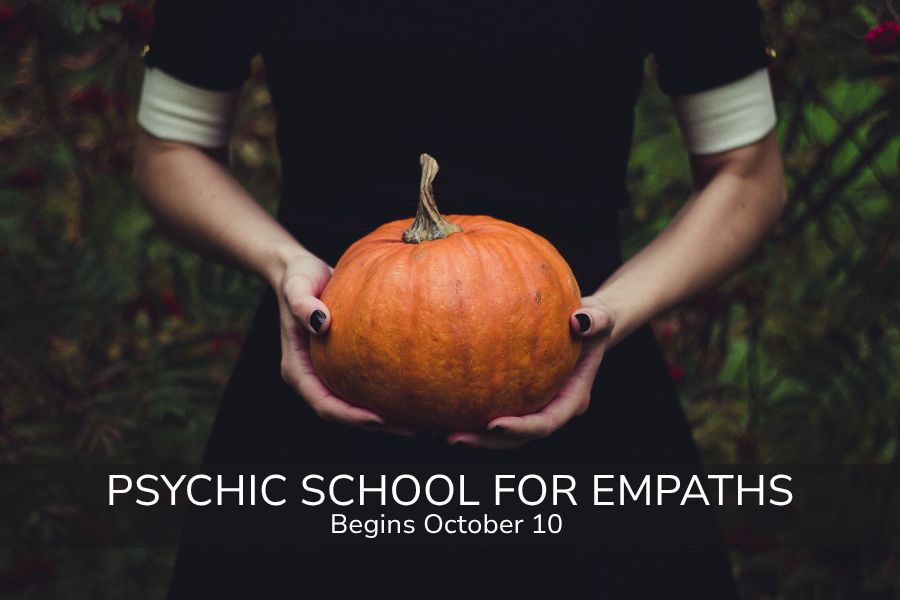
This is exactly why I created Psychic School for Empaths. It is not about turning you into someone you are not, and it is definitely not about trying to manufacture dramatic supernatural experiences. It is about reconnecting with an intuitive ability that may have been quietly operating underneath your everyday life for years and learning how to work with it intentionally.
Over 21 days, we practice noticing what you receive, understanding the different ways intuition communicates, separating intuitive information from fear and mental noise, and developing enough experience that you can begin trusting yourself. You get the opportunity to experiment, observe, practice, and discover what your particular intuitive language feels like.
And yes, I believe we are wired for this. I believe psychic awareness is natural. But that does not make it boring or ordinary. There is something genuinely magical about realizing you can consciously collaborate with energy, pay attention to the unseen currents around you, and move through your life with a greater sense of connection, curiosity, and awareness.
You begin to experience the world differently, not because you have left reality behind, but because you are finally allowing yourself to experience more of it.
Notice. Receive. Trust.
If you are ready to reconnect with the intuitive part of yourself that you may have been taught to quiet a long time ago, I would love to have you join me in Psychic School for Empaths.