
I have kept quiet about channeling for a long time, mostly because I have never wanted to criticize the way another person experiences or expresses their spiritual connection. These experiences are personal, and none of us can know exactly what happens within another person’s consciousness. At the same time, there are performative and frankly bullshit aspects of modern channeling that deserve discussion. Strange voices, invented accents, dramatic physical changes, grandiose identities, and claims of exclusive spiritual access have made channeling appear far more mysterious and inaccessible than it really is.
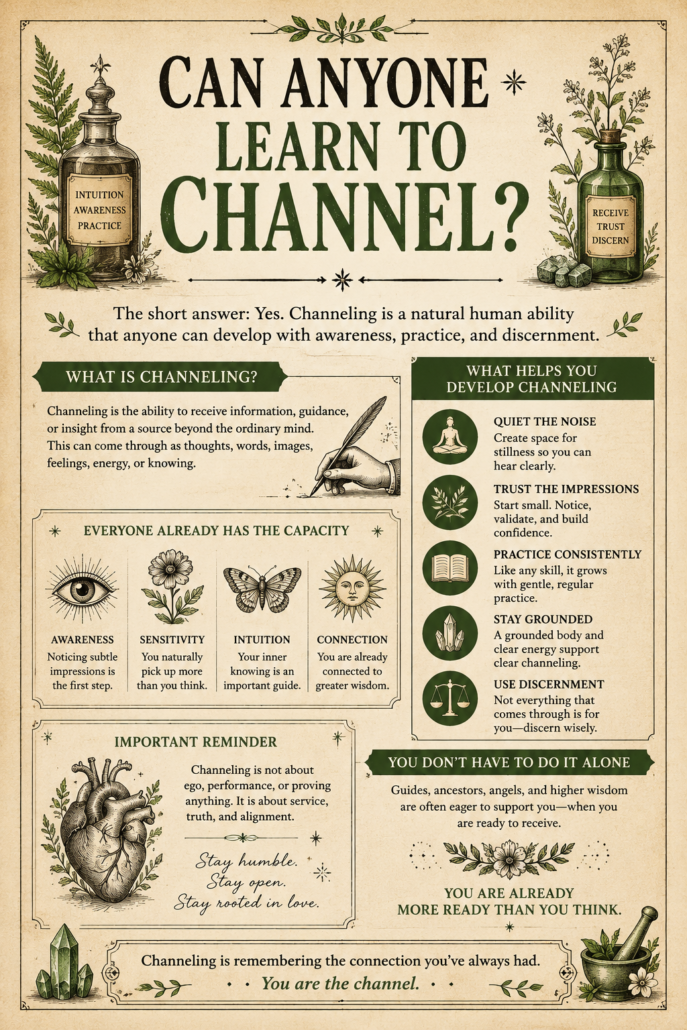
I believe channeling is much simpler, more natural, and more human than we have been led to believe. It is not a supernatural gift reserved for a chosen few, and it does not require someone to become a different personality or hand over control of their body to a mysterious entity. Channeling is the process of opening ourselves to wisdom, creativity, insight, and intelligence beyond the limits of our ordinary, analytical thinking. We may call the source Spirit, the higher self, the higher mind, universal consciousness, infinite intelligence, God, guides, angels, or something else entirely. The name is less important than the experience of connecting with a deeper level of awareness.
What Is Channeling?
We are all part of what I sometimes call the cosmic soup. We are not isolated fragments of consciousness trying to reach something that exists far beyond us. We are already participating in a larger field of intelligence that connects us to one another, to life, and to Spirit. Our individual minds may feel separate, but beneath our everyday thoughts, identities, fears, and conditioning lies a much deeper connection. When we become quiet enough to perceive that connection, we are channeling.
This happens far more often than most people realize. A writer who receives a complete idea seemingly out of nowhere may be channeling. An artist who feels that a painting wants to create itself may be channeling. A teacher who suddenly finds the exact words a student needs to hear may be channeling. A Tarot reader who looks at familiar cards and receives an interpretation that goes far beyond their traditional meanings may be channeling. Even an ordinary person who becomes still, moves beyond fear, and accesses an unexpected moment of clarity may be touching that same field of consciousness.
Channeling does not always arrive with fireworks, visions, voices, or dramatic physical sensations. More often, it feels like a quiet thought, a subtle knowing, a sentence that seems to appear fully formed, or a perspective that is wiser than the one we were holding a moment earlier. It can be so natural that we immediately dismiss it as our imagination. We assume that genuine spiritual communication must feel foreign, powerful, or unmistakably supernatural, when in reality it often sounds very much like our own voice.
That does not make it less meaningful. Consciousness must communicate through the mind, vocabulary, memories, symbols, and personality of the person receiving the information. Every spiritual message passes through a human filter. No channeler, psychic, medium, teacher, or intuitive practitioner is a perfectly neutral receiver. We all have beliefs, expectations, emotional wounds, desires, cultural influences, and personal interpretations that shape what we perceive and how we describe it. This is not necessarily a flaw in the process. It is simply one of the realities of being human.
We Are All Channelers
I do not believe channeling is reserved for a small group of specially selected people. The ability to receive inspiration, insight, and spiritual guidance is part of our human birthright as spiritual beings. Some people are naturally more sensitive to subtle information, and some have spent years developing their awareness, but the connection itself does not belong to an elite group.
You do not need to be chosen, initiated, or granted permission by another spiritual practitioner. You do not need to adopt a different personality, speak in an unusual voice, or claim contact with an impressive being. You already participate in the consciousness you are trying to reach. The work is not gaining access. The work is learning how to listen, interpret, and discern what you receive.
When we tap into our creativity, wisdom, compassion, and brilliance, we are channeling. When we move beyond our conditioned reactions and hear the quieter intelligence underneath them, we are channeling. When the right words, ideas, or images flow through us with an ease that surprises us, we are participating in a much larger conversation.
How I Discovered I Was Channeling
My own understanding of channeling developed gradually. I did not have a single dramatic moment when a named being appeared, announced itself, and informed me that I had been chosen for an important spiritual mission. Instead, I began to recognize channeling when I finally said yes to my work and started treating it as a collaboration with Spirit. As I stopped trying to force answers and began listening more carefully, I noticed that information often arrived with a clarity and intelligence that felt different from my normal mental chatter.
The more I trusted this collaboration, the more natural it became. Guidance came through automatic writing, meditation, Tarot readings, quiet reflection, signs around town, and unexpected moments of synchronicity. Sometimes it felt as though I were receiving information from outside my everyday awareness. At other times, it felt like a wiser and more expansive part of myself had stepped forward. Eventually, I stopped feeling the need to determine exactly which part of consciousness was speaking.
For years, I have referred to my spirit guides as “they,” “them,” or simply “you guys.” I do not have a formal list of names, titles, ranks, or spiritual job descriptions. I include my higher self as part of “them” because I do not experience a hard dividing line between my higher consciousness and the larger field of wisdom I am accessing. To me, channeling is not about separating consciousness into a complicated cast of spiritual characters. It is about entering into a relationship with intelligence that is both within us and beyond the limits of our everyday personality.
The Day Spirit Answered Me With a Bottle Cap
By the time this particular experience happened, I had been working as a psychic medium in Long Beach for about three years. My relationship with Spirit was warm, familiar, and completely informal. I called my guides “they,” “them,” and “you guys,” and whenever they surprised or delighted me, which happened almost daily, I would exclaim, “Oh my God, they’re so good!”
Around that time, I began visiting several spiritual centers and attending different classes. One kundalini yoga class stood out in particular. The instructor dressed entirely in white and wore a turban, and the atmosphere carried a level of ceremony and formality that was very different from my own spiritual practice. As I observed other practitioners, I began to notice how reverently and formally many of them addressed Spirit.
This made me unexpectedly nervous. I started wondering whether I had been too casual. Was I being rude or disrespectful by referring to my guides as “you guys”? Was I supposed to address them with titles, names, or some greater level of spiritual decorum? Had I been collaborating with Spirit for years without observing the proper etiquette?
I decided to meditate on the question and ask them directly how they preferred to be addressed. Afterward, I went to Yoga on the Bluff, my favorite yoga studio in the world. During the class, I moved into downward dog with a clear mind and felt something metallic underneath my hand, extending slightly over the edge of my mat. I tapped it, picked it up, and discovered that it was a Jarritos bottle cap.
Printed on the bottle cap were the words, “Qué Buenos Son!”
I knew enough Spanish from high school to understand the message: “They’re so good.”
Tears began running down my face because I instantly understood the answer. They did not care what I called them. They were not bound by language, titles, formality, or human rules of etiquette. They knew exactly how I spoke about them, and they responded in the language of our relationship. They also made it abundantly clear that they had a fabulous sense of humor.
That bottle cap answered my question more completely than a long, solemn message ever could have. I still call them “they,” “them,” and “you guys.” I still tell them how good they are, and I still call on them daily.
Spirit Guides, Names, and Human Labels
People naturally want to name things. Names help us organize our experiences and give us a way to relate to what we cannot physically see. There is nothing inherently wrong with giving a guide a name or perceiving a particular spiritual identity. For some people, that relationship may be meaningful and supportive. However, I do not believe consciousness needs a name in order to communicate with us, and I do not automatically assume that every name received during channeling belongs to a separate, objectively existing entity.
The information we connect with often has the name we give it. A person may interpret a loving, wise presence as an angel, a guide, an ancestor, an ascended master, an extraterrestrial intelligence, or the higher self. Another person may experience the same quality of consciousness without assigning it an identity at all. Our minds use familiar language, imagery, archetypes, and belief systems to translate subtle experiences into something we can understand. The label may help us relate to the experience, but the label should not be confused with proof.
My experience with the bottle cap confirmed something I had already begun to suspect. Spirit does not seem particularly concerned with the categories, titles, and distinctions that matter so much to human beings. Consciousness is not limited by language, and it is not standing on ceremony. It communicates through whatever form can reach us, whether that is a thought, a Tarot card, a dream, a song, a conversation, a symbol, or a piece of litter that happens to appear beneath our hand during downward dog.
How Spirit Communicates Through Signs and Synchronicities
Signs are another form of channeling because they involve a meaningful exchange between our awareness and the larger field of consciousness. We may ask a question and then notice a phrase on a passing truck, a license plate, a storefront, a billboard, a book title, or a song playing at exactly the right moment. The message may appear through something completely ordinary, but its timing and relevance make it impossible to ignore.
This does not mean that every object, number, or random event carries a profound spiritual message. Discernment is still necessary. When we become desperate for signs, we can begin assigning meaning to everything and using coincidence to confirm what we already want to believe. Genuine signs tend to arrive with a particular clarity. They do not require elaborate interpretation, and they often carry a sense of recognition that is immediate and deeply personal.
The Jarritos bottle cap was meaningful because it directly answered the exact question I had asked. It used a phrase I had been repeating for years, appeared in an unexpected place, and reached me while my mind was quiet and receptive. I did not have to consult a spiritual dictionary or search online for the hidden meaning of bottle caps. I knew what it meant the moment I read it.
Signs around town can work in the same way. A message on a theater marquee, a line painted on the side of a building, a street name, a bumper sticker, or a phrase overheard in passing may reflect an answer we have been seeking. Spirit uses the language, images, and environment available to us. The communication does not always happen inside meditation. Sometimes it is waiting at a stoplight.
The Importance of Discernment in Channeling
A person can be sincere about what they are experiencing and still misunderstand it. A channeler can honestly believe that they are speaking for a particular being while also filtering the information through imagination, expectation, personal belief, or unconscious desire. Sincerity does not guarantee accuracy. Confidence does not guarantee truth. A dramatic presentation certainly does not guarantee either one.
This is why discernment is so important. We need to consider the quality of the information, the effect it has on us, and the authority being claimed by the person delivering it. Does the message encourage wisdom, compassion, personal responsibility, and clear thinking? Does it respect free will? Does it help people develop their own connection, or does it make them more dependent on the channeler?
We also need enough self-awareness to recognize our own filters. Fear can disguise itself as intuition. Desire can disguise itself as guidance. Unresolved emotional wounds can influence what we believe Spirit is telling us. Channeling does not exempt us from honest self-examination. In fact, the clearer we become about our own patterns, motives, and biases, the more responsibly we can work with spiritual information.
What Channeling Is Not
Channeling is not automatically authentic because someone closes their eyes, changes their posture, alters their voice, or begins speaking with an unusual accent. It is possible that some people genuinely experience physical or vocal changes when they enter an altered state of consciousness. The human nervous system is complex, and spiritual experiences can affect people in different ways. I am not claiming that every unusual voice is deliberately fake.
I am saying that a changed voice is not evidence of higher consciousness. An accent does not make a message more spiritual. A dramatic entrance does not prove that an ancient master, star being, angelic council, or interdimensional intelligence has arrived. The performance may be compelling, but it should never be mistaken for proof. The quality of the information matters far more than the manner in which it is delivered.
Channeling is also not a spiritual permission slip that allows someone to make irresponsible claims without accountability. Saying that a message came from Spirit does not place it beyond criticism. No one should be able to avoid questions by insisting that their source is too advanced for ordinary people to understand. Spiritual information should be examined with the same intelligence and discernment we would apply to any other form of guidance.
The Problem With Performative Channeling
The spiritual world has often rewarded people for appearing extraordinary. Quiet wisdom is not always as marketable as a dramatic performance. A grounded person speaking in their natural voice about compassion, self-awareness, and personal responsibility may receive less attention than someone delivering urgent announcements from a galactic council. Spectacle attracts curiosity, and mystery can be profitable.
When channeling becomes performative, it creates unnecessary distance between the practitioner and the audience. The channeler appears to have rare access to a source that everyone else can only experience secondhand. Followers may begin to believe that the channeler is more evolved, more spiritually important, or more trustworthy than their own inner guidance.
The more elaborate the mythology becomes, the easier it is for people to surrender their discernment. A channeler may claim an exclusive relationship with a powerful being, present themselves as the only reliable interpreter of its teachings, and build an entire business around maintaining that authority. The audience is encouraged to keep returning for answers instead of developing the confidence to listen for themselves.
This does not mean that every popular channeler is dishonest or that every dramatic spiritual experience is fabricated. It means that audiences should remain aware of the social, emotional, and financial incentives surrounding spiritual performance. People can become attached to being seen as special. They can exaggerate, embellish, or unconsciously shape their experiences to meet the expectations of their followers.
No channeler should be treated as infallible. Channelers are human beings with egos, fears, ambitions, blind spots, emotional wounds, and financial needs. They can misinterpret information, project their beliefs, or become attached to their own spiritual identity. They can make predictions that do not come true. They can receive an insight that is helpful in one context and mistakenly present it as universal truth. Spiritual language does not remove the need for critical thinking.

Channeling, Imagination, and the Human Mind
One of the most common fears people express when they begin exploring channeling is that they may be making everything up. This fear is understandable because subtle information often enters through the imagination. We may receive an image, phrase, memory, symbol, or inner conversation, and there is rarely an objective way to prove exactly where it came from.
However, imagination and intuition are not opposites. Imagination may be one of the primary tools consciousness uses to communicate with us. The mind translates subtle information into forms we can recognize. A symbolic image may carry an insight that cannot be expressed as a straightforward sentence. A memory may surface because it contains the emotional pattern we need to examine. A Tarot card may act as a visual doorway through which a deeper message becomes available.
The fact that the mind participates in the process does not automatically make the experience false. Every form of communication requires translation. Even ordinary conversation is interpreted through memory, language, belief, and context. Channeling is no different. We receive something subtle, and our human consciousness gives it shape.
At the same time, not every thought is spiritual guidance. Not every emotional impulse is intuition, and not every image that appears in meditation is a message from beyond. Discernment develops through self-awareness, practice, and a willingness to question our own interpretations. We need to know the difference between fear and intuition, desire and guidance, fantasy and meaningful symbolism. We also need enough humility to admit when we are unsure.
How to Recognize Grounded Spiritual Guidance
A helpful message usually feels clear without being coercive. It may challenge us, but it does not manipulate us through fear. It respects our agency and does not demand that we abandon common sense. Genuine guidance often brings us back to responsibility, honesty, compassion, patience, and practical action. It does not usually tell us that we are superior, uniquely chosen, or exempt from ordinary human accountability.
Grounded guidance also leaves room for interpretation. It does not insist that there is only one possible future or one correct decision. It may illuminate a pattern, reveal an option, or encourage us to look more honestly at a situation, but it does not take away our responsibility to choose.
Channeling should expand our awareness, not narrow it. It should support our relationship with our own wisdom rather than replacing that relationship with dependence on someone else. A responsible teacher, psychic, or channeler should help people recognize and trust their own access to consciousness.
My Favorite Ways to Connect With Spirit
My favorite methods of channeling are simple because I do not believe spiritual connection needs to be complicated. Automatic writing, meditation, Tarot cards, silence, and signs are the practices through which I most naturally experience collaboration with Spirit.
Automatic writing is one of the clearest ways I move beyond my habitual thoughts and allow deeper insight to emerge. I may begin with a question and write freely without editing or judging the words as they arrive. Sometimes the writing feels like a conversation with Spirit. Sometimes it reveals something I already knew but had not been willing to acknowledge. Both experiences are valuable because both move me toward greater awareness.
Meditation helps me become receptive by quieting the constant movement of the analytical mind. I do not always receive words, visions, or recognizable messages while meditating. Often, meditation simply creates the internal space in which clarity can emerge later. The insight may arrive while I am walking, making tea, taking a shower, driving through town, or moving through an ordinary part of my day. Channeling is not limited to the moments when we are sitting with our eyes closed.
Tarot gives intuitive information a visual language. The cards provide structure, symbols, and archetypes that help consciousness communicate in a form the mind can interpret. During a reading, I am not merely repeating memorized card meanings. I am paying attention to the relationship between the cards, the question, the person’s energy, and the impressions that arise. Tarot does not replace intuition. It focuses and supports it.
Silence may be the most essential practice of all. We live in a world filled with opinions, predictions, advice, noise, and constant stimulation. We consume other people’s interpretations so continuously that we can lose touch with our own inner awareness. Silence allows the surface noise to settle. It gives us a chance to notice what remains when we are no longer reacting to everyone else.
Signs remind me that communication with Spirit is not confined to formal spiritual practice. A message can find us through an object on the sidewalk, a phrase on a storefront, a song on the radio, or a bottle cap beneath a yoga mat. Spirit is creative, resourceful, and often very funny.
How to Begin Channeling
Anyone can begin developing this connection. The process does not require a dramatic ritual or a declaration that a spiritual being has chosen you. It begins with creating space, becoming quiet, and asking a sincere question. You might ask what would be helpful for you to understand, what you are not seeing clearly, or what your higher self wants you to recognize.
Then listen without demanding a particular kind of answer. The first response may be a thought, a feeling, an image, a sentence, a physical sensation, or a subtle knowing. You may notice a relevant phrase later that day, encounter a meaningful symbol, or feel drawn to a particular Tarot card. Write down what you receive before analyzing it, then return to it later and consider whether it feels grounded, compassionate, and useful.
Channeling becomes clearer through observation and practice, not through forcing an experience or trying to imitate someone else. You begin to recognize the difference between your anxious mind and your deeper knowing. You learn how Spirit tends to communicate with you, which may be entirely different from the way another person receives information.
You do not need to change your voice. You do not need to invent a spiritual identity. You do not need to convince anyone that your guidance comes from an impressive source. You do not need to perform at all. The work is to become more honest, more receptive, and more aware of the difference between your conditioned reactions and your deeper wisdom.
Channeling Is Our Spiritual Birthright
Channeling is consciousness communicating through consciousness. It is the experience of allowing a greater intelligence to meet us through our own minds, hearts, creativity, and intuition. It can happen through writing, art, music, teaching, Tarot, prayer, meditation, dreams, synchronicities, or an ordinary moment of clarity.
It is not reserved for a spiritual elite. We are all channelers because we are all part of the consciousness we are attempting to reach. The connection is already present. The ability to listen, interpret, and trust it can be strengthened, but access itself is our birthright as spiritual beings.
When we move beyond fear, quiet the noise, and tap into our own brilliance, we are channeling. No strange voice, elaborate title, or dramatic performance is required. Spirit knows who we are, understands the language of our relationship, and has more ways of reaching us than we could ever imagine!