
There’s something wonderfully transformative about gratitude. It has a way of shifting our attention from what’s missing to what’s already present, reminding us that even in the middle of uncertainty, there are things worth appreciating. A warm cup of coffee, a conversation with a friend, a peaceful morning, or an unexpected kindness can become a small but meaningful reminder that life is still offering us something beautiful.
But somewhere along the way, gratitude became tangled up with the idea that we should always be positive. We’re encouraged to count our blessings, look on the bright side, and focus only on what we want to attract. And while there’s certainly value in directing our attention toward what feels good, I think this interpretation misses something important.
Gratitude isn’t about pretending everything is wonderful. It’s about recognizing what is wonderful, even when everything isn’t.
True gratitude allows room for the full human experience. We can appreciate our lives while acknowledging that certain things need to change. We can be thankful for what we have while still wanting something more. We can experience disappointment, grief, frustration, or uncertainty without somehow failing at being spiritual.
In fact, I believe gratitude becomes much more powerful when we stop treating it as an obligation to feel good and begin experiencing it as a genuine relationship with life.
The Problem With Forced Positivity
If you’ve spent much time in spiritual or manifestation communities, you’ve probably heard the familiar advice to keep your vibration high, think positive thoughts, and avoid focusing on anything negative. I’ll admit, I’ve preached that message myself over the years. But as my own understanding of spirituality has evolved, I’ve come to recognize that there’s much more to living consciously than simply maintaining a positive attitude.
The underlying intention is understandable. Our thoughts influence how we interpret our experiences, and our attitudes can affect the choices we make. When we habitually focus on everything that’s going wrong, we may overlook possibilities that are right in front of us.
But there’s a difference between consciously directing our attention and denying what we’re experiencing.
Imagine someone who is struggling financially. They’re worried about paying their bills, wondering how to make ends meet, and feeling genuinely frightened about the future. Telling that person to simply focus on abundance might sound spiritually encouraging, but it can also leave them feeling as though their perfectly reasonable concerns are somehow responsible for their circumstances.
That’s where positive thinking can become toxic.
We begin judging ourselves for having negative emotions. We worry that acknowledging fear will attract more things to fear. We may even convince ourselves that expressing sadness, anger, or disappointment means we’re somehow blocking our blessings.
I don’t believe that’s how spirituality works.
Our emotions are part of being human. They carry information about our needs, experiences, boundaries, and desires. Ignoring them doesn’t necessarily make us more spiritually evolved. Sometimes it simply makes us less honest with ourselves.
You can be grateful and still be having a difficult time. Both things can be true.
Gratitude Is an Awareness Practice
One of the things I love about gratitude is that it invites us to become more present.
So much of our mental energy is spent revisiting the past or anticipating the future. We replay conversations, reconsider decisions, worry about outcomes, and imagine all the things that might go wrong. Meanwhile, the life we’re actually living is happening right here, in this moment.
Gratitude gently brings our attention back.
When we pause long enough to appreciate something, even something ordinary, we interrupt that constant mental activity. We become aware of our surroundings, our experiences, and the small comforts we might otherwise take for granted.
Perhaps you notice how beautiful the light looks coming through your window. Maybe you appreciate the quiet of your home after a busy day, the pleasure of preparing a good meal, or the simple fact that someone remembered to check in on you.
None of these experiences requires you to believe that your life is perfect. They simply ask you to notice that something good is present.
And the more we practice noticing, the easier it can become to recognize those moments.
This is one reason I think gratitude is so closely connected to intuition. Both practices encourage us to slow down, pay attention, and become more conscious of our experiences. Instead of moving through life on autopilot, we begin to recognize the subtle things that might otherwise escape our attention.
Gratitude, Abundance, and the Art of Manifesting
In manifestation teachings, gratitude is often described as a way of aligning ourselves with abundance. The idea is that when we appreciate what we already have, we cultivate an inner experience of having enough rather than constantly reinforcing a sense of lack.
It’s not having what you want, it’s wanting what you’ve got.
Sheryl Crow – Soak Up The Sun
I find this perspective useful, especially when we understand it as a shift in consciousness rather than a magical formula.
Think about the difference between approaching life with the belief that nothing ever works out for you and approaching it with the understanding that possibilities still exist, even when circumstances are challenging.
Neither perspective guarantees a particular outcome. However, they can influence what we notice, how we respond to opportunities, and whether we feel capable of taking meaningful action.
Gratitude helps us recognize the resources, relationships, abilities, and experiences that are already supporting us. It reminds us that our lives contain more than whatever problem happens to be demanding our attention. And that awareness can create a different foundation for manifesting.
Instead of approaching our desires from a place of desperation, we can begin to approach them with curiosity, appreciation, and a greater sense of possibility.
For example, if you’re hoping to create a more fulfilling career, gratitude might help you recognize the skills you’ve developed, the people who have encouraged you, and the experiences that have prepared you for something new. Those realizations don’t eliminate the need to search for opportunities, develop your abilities, or take practical steps. They simply help you recognize that you aren’t starting from nothing.
I often return to the spiritual principle that our inner world influences how we experience our outer world. Not because every circumstance is something we’ve consciously or unconsciously created, but because our beliefs, expectations, and choices participate in shaping the direction of our lives.
Gratitude doesn’t replace action. It helps us approach action from a more grounded and receptive state of mind.
You Can Appreciate What You Have and Still Want More
There’s another misconception about gratitude that I think deserves attention: the idea that being truly grateful means we should be satisfied with everything exactly as it is. I’ve never understood why appreciation and ambition are sometimes treated as opposites.
You can love your home and dream of living somewhere else. You can appreciate your work while recognizing that you’re ready for a different opportunity. You can be grateful for the relationships in your life while wanting deeper connections, healthier boundaries, or more companionship.
Desire isn’t necessarily a rejection of what we already have. Sometimes it’s simply life encouraging us to grow.
Nature gives us a beautiful example of this. A tree doesn’t stop growing because it has already developed strong roots. It continues reaching toward the light, producing new branches, leaves, and blossoms as the seasons change. We can do the same.
Gratitude helps us honor where we are, while our desires help us imagine where we might go.
When these two qualities work together, we can pursue meaningful changes without making our present circumstances the enemy. We don’t have to postpone happiness until every goal has been accomplished, nor do we have to abandon our dreams in order to appreciate our lives today.
There’s room for both contentment and expansion.
Finding Gratitude During Difficult Seasons
Of course, gratitude feels much easier when life is going well. It’s another matter entirely when we’re facing loss, illness, financial uncertainty, relationship problems, or unexpected changes.
During those seasons, being told to find something to be thankful for can feel like just another demand. That’s why I believe gratitude should always be an invitation rather than an assignment.
Some days, you may feel genuinely grateful for dozens of things. Other days, simply making it through the afternoon might be enough. There may even be days when gratitude feels completely out of reach, and that’s okay, too.
You don’t need to manufacture appreciation for an experience that hurts. You can acknowledge that something is unfair, disappointing, or painful without searching for a spiritual explanation that makes it acceptable.
Sometimes the most meaningful gratitude during difficult times is directed toward something small and immediate. A person who listens without trying to fix everything. A comfortable place to rest. A moment when your mind finally becomes quiet. An unexpected laugh in the middle of an otherwise exhausting day.
These moments don’t erase the difficulty. They remind us that the difficulty isn’t the entirety of our experience. And sometimes that’s enough.
A Simple Practice for Cultivating Genuine Gratitude
You’ve probably heard the suggestion to write down three things you’re grateful for every day. It’s a lovely practice, and for many people, it can be helpful. But like any spiritual exercise, it can become mechanical when we do it simply because we think we’re supposed to.
I’d like to suggest a slightly different approach. Rather than trying to create a list of things you should appreciate, begin by asking yourself what you genuinely enjoyed, valued, or felt supported by today.
Maybe something went better than expected. Perhaps you experienced a moment of peace, learned something useful, or handled a challenging situation with more patience than you might have in the past.
Take a moment to remember the experience. Notice what made it meaningful and how it felt to you. Then consider a second question: What would I like to welcome more of into my life? This is where gratitude and conscious creation begin to work together.
If you’re grateful for a peaceful afternoon, perhaps you’d like to create more opportunities for rest. If you enjoyed a meaningful conversation, maybe you’re ready to make more time for friendship. If you felt especially creative while working on a project, perhaps your spirit is encouraging you to make creativity a greater priority.
Your gratitude becomes more than a reflection on what has already happened. It becomes information about what matters to you and what you might want to cultivate next.
You can practice this through journaling, meditation, a quiet walk, or simply taking a few minutes before bed to reflect on your day. There’s no special ritual required. Your attention and sincerity are enough.
A Three-Card Tarot Spread for Gratitude and Abundance
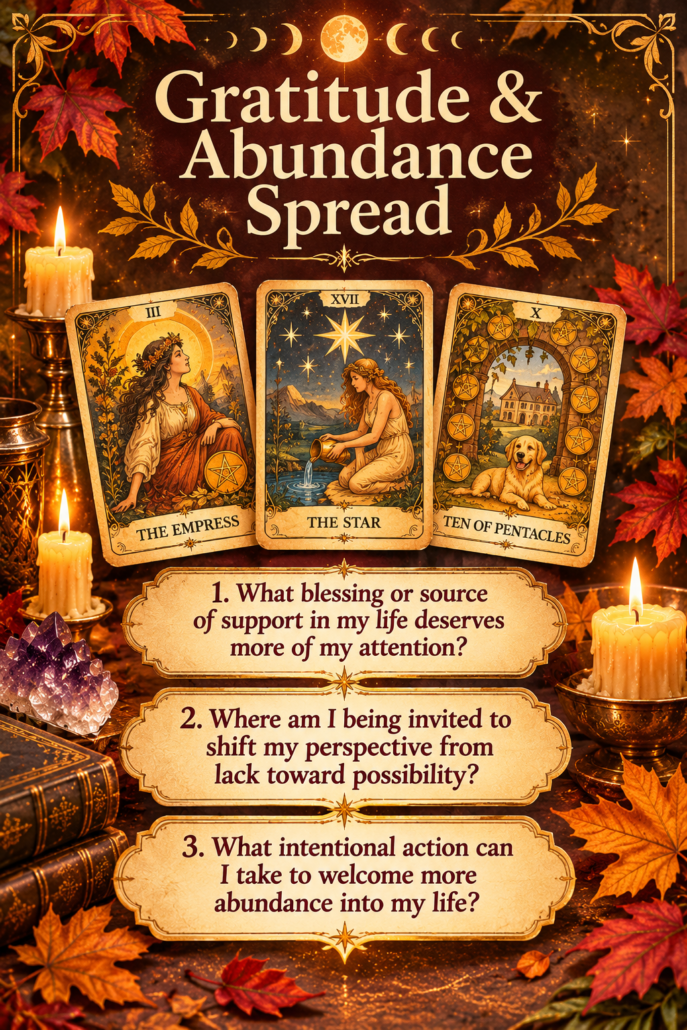
Since Tarot is one of my favorite tools for self-reflection, I also love the idea of using the cards to explore gratitude in a more meaningful way.
Rather than asking what wonderful things are coming your way, try asking questions that help you recognize what’s already supporting you and how you can consciously participate in creating more of what you desire.
Pull three cards and reflect on the following questions:
- What blessing or source of support in my life deserves more of my attention?
- Where am I being invited to shift my perspective from lack toward possibility?
- What intentional action can I take to welcome more abundance into my life?
As always, you don’t need to approach the cards as predictions. Think of them as invitations to explore your thoughts, feelings, beliefs, and possibilities from a different perspective.
Pay attention to the imagery, the emotions the cards evoke, and any personal associations that arise. Sometimes the most valuable message isn’t found in a traditional card definition, but in the insight that comes when we allow ourselves to look at an experience differently.
Gratitude as a Way of Living
Ultimately, I don’t think gratitude is something we’re meant to master or perform perfectly. It’s a relationship we develop with ourselves, our experiences, and the world around us.
Some days that relationship feels effortless. Other days, it requires a little more intention. And sometimes, the most compassionate thing we can do is acknowledge exactly where we are without asking ourselves to feel differently.
I also believe gratitude can deepen our sense of spiritual connection. Whether you understand that connection through God, Spirit, the Universe, your higher self, or simply the extraordinary experience of being alive, appreciation can remind us that we’re participating in something much larger than our everyday worries.
There is so much in life we cannot control. We can’t guarantee that every desire will manifest, every relationship will last, or every challenge will resolve itself according to our preferred timeline.
But we can become more conscious of where we place our attention. We can recognize the good without denying the difficult. We can appreciate what is present while remaining open to what is possible. And perhaps that’s where the real magic of gratitude begins. Not in convincing ourselves that everything is wonderful, but in discovering that even an imperfect life can contain moments of beauty, meaning, connection, and possibility.
Gratitude isn’t about having everything you want. It’s about developing a deeper appreciation for what you have while remaining open to everything you have yet to experience.
And to me, that’s a beautiful way to live.
A Little Food for Thought
As we move into this season of gratitude, I’d love to leave you with a question: What is something in your life that you’ve learned to appreciate more deeply over time?
Perhaps it’s something you once took for granted, something you’ve worked hard to create, or something simple that brings you unexpected joy.
Whatever comes to mind, give yourself a moment to appreciate it. Not because you need to raise your vibration or attract your next blessing, but simply because it’s worth noticing.
And if you’re navigating a difficult season, I hope you’ll give yourself permission to experience gratitude on your own terms, without pressure or expectations.
Wishing you a season filled with genuine appreciation, meaningful connections, and a little everyday magic.
Charlene
P.S. If you enjoy exploring intuition, spirituality, manifestation, and the mysteries of everyday life, I invite you to listen to the Enchanted Empath Podcast. It’s a welcoming space where we explore spiritual ideas, share practical wisdom, and discover new ways to bring greater awareness and intention into our lives.







Leave a Reply