If you’re an empath, you’ve probably had this experience more than once: you feel something strongly, but you’re not sure whether it’s your intuition speaking or your anxiety taking over. Maybe you get a strange feeling about a person, a job, a decision, or a situation that hasn’t even happened yet. You sense that something is trying to get your attention, but then your mind jumps in and starts analyzing, questioning, and second-guessing everything. Suddenly, what felt simple becomes confusing.
Learning to tell the difference between intuition and anxiety is one of the most important skills an empath can develop. The good news is that you don’t need to become more psychic in order to do it. In my experience, empaths are already naturally intuitive. The real work is learning how your intuition communicates with you, understanding how your body responds to energy, and becoming confident enough to trust what you are receiving.
We are always connected with Spirit. We do not have to force that connection or somehow become spiritual enough to earn it. What changes when we meditate, journal, pull Tarot cards, pray, sit quietly, or practice psychic development is our level of attention. When we become more intentional and receptive, we are better able to notice the information that has been there all along. For many empaths, that information comes through the body before it ever reaches the thinking mind.
The easiest way to begin separating intuition from anxiety is to pay attention to three things: where you feel the sensation, what the energy feels like, and when the message arrives. These three clues can help you recognize patterns in your own intuitive language and give you a more grounded way to trust yourself.
Start With the Body
Before you try to figure anything out, think of one situation from the past week that has left you uncertain. It could be a relationship, a work decision, a conversation, an invitation, or something you simply cannot stop thinking about. Hold that situation lightly in your mind, not because you need to solve it right now, but because it gives you something real to practice with as you read.
The first clue is location. Anxiety and intuition often feel different in the body. For many people, anxious energy feels high and tight. You may notice tension in your chest, shallow breathing, pressure around your shoulders, a buzzing sensation, a tight throat, or thoughts that feel as if they are circling endlessly through your head. There can be a sense of bracing, as if your whole system is preparing for something to go wrong.
Intuition often feels deeper and more grounded. You may notice a response in your belly, gut, heart, or somewhere lower in the body. Sometimes it feels like a subtle dropping sensation, a pull, a settling, an opening, or simply a very clear sense of yes or no. We use the phrase “gut feeling” for a reason. The body often knows before the mind has had time to create an explanation.
Try placing one hand over your chest and one over your belly while you think about the situation you chose. Rather than asking your mind to decide what the feeling means, simply notice where your attention goes. Pay attention to whether the sensation feels high, tense, and activated or lower, steadier, and more grounded. There is no need to make anything happen. The point is simply to begin observing how your own body communicates with you.
Notice the Quality of the Energy
The second clue is the quality of the energy itself. I often tell my students that everything is always telling on itself. Energy has a texture and a tone, and when you stop focusing only on the story around a situation, you can begin noticing what the energy itself feels like.
Anxiety tends to come with pressure and urgency. It often feels as though you have to make a decision immediately, solve everything at once, or keep thinking until you finally reach certainty. You may find yourself weighing endless pros and cons, replaying conversations, imagining worst-case scenarios, or trying to convince yourself that one choice must be the right one. There is usually a lot of mental effort involved.
Intuition is often much quieter. Even when it is warning you about something, it tends to feel clear, simple, and strangely neutral. You may not like the answer, but there is often a sense of recognition underneath your emotional reaction. Instead of feeling like you have to build a case, you simply know. It may be a quiet sense that a job is not right for you, that you need to wait before making a move, or that someone is not being completely honest. The message itself does not usually need to argue.
I once worked with a student who was considering a job opportunity that looked wonderful on paper. Everything about it seemed to say she should take it, and she could list plenty of logical reasons why it made sense. Yet every time she imagined herself accepting the position, her body felt heavy and contracted. Her mind was making a strong case for yes, but her body was already saying no. That is an important part of psychic development: learning to recognize the information you are already receiving before you talk yourself out of it.
When you bring your own situation to mind, ask yourself whether the energy feels frantic and pressured or quiet and clear. Sometimes the answer is the thing that lights you up. Other times, the answer is simply the thing that allows your body to soften. Either way, you are learning to pay attention to the difference between pressure and knowing.
Pay Attention to What Came First
The third clue is timing, and this is often one of the most useful ways to recognize intuition. Intuition tends to arrive before the story. It is often immediate, subtle, and uninvited. You walk into a room and sense something. A person suddenly crosses your mind. You see an opportunity and instantly feel interested. Someone says something and you know there is more happening beneath the words. You may not have any logical reason for the response; it simply appears.
Then the mind arrives and begins analyzing what just happened. You start asking why you would think that, whether you imagined it, whether you are being unreasonable, or whether you should ignore it. The original impression may have taken only a second, but the mental debate can go on for hours.
Anxiety tends to live in that second layer. It builds a story, revisits the same question, rehearses possible outcomes, and tries to predict what will happen next. This does not mean every spontaneous thought is intuitive, of course, and part of developing discernment is observing yourself over time. Still, it is worth paying attention to the order in which things happen. If there was a quiet knowing before the mental argument began, that first response deserves your attention.
Instead of forcing yourself to decide whether a feeling is psychic or anxious in the moment, start becoming curious about your patterns. Ask yourself what you knew before you started thinking so hard. Over time, you may begin to recognize that your intuition has a familiar way of arriving, while anxiety has its own familiar rhythm.
The Hanged Man: Wait for the Aha
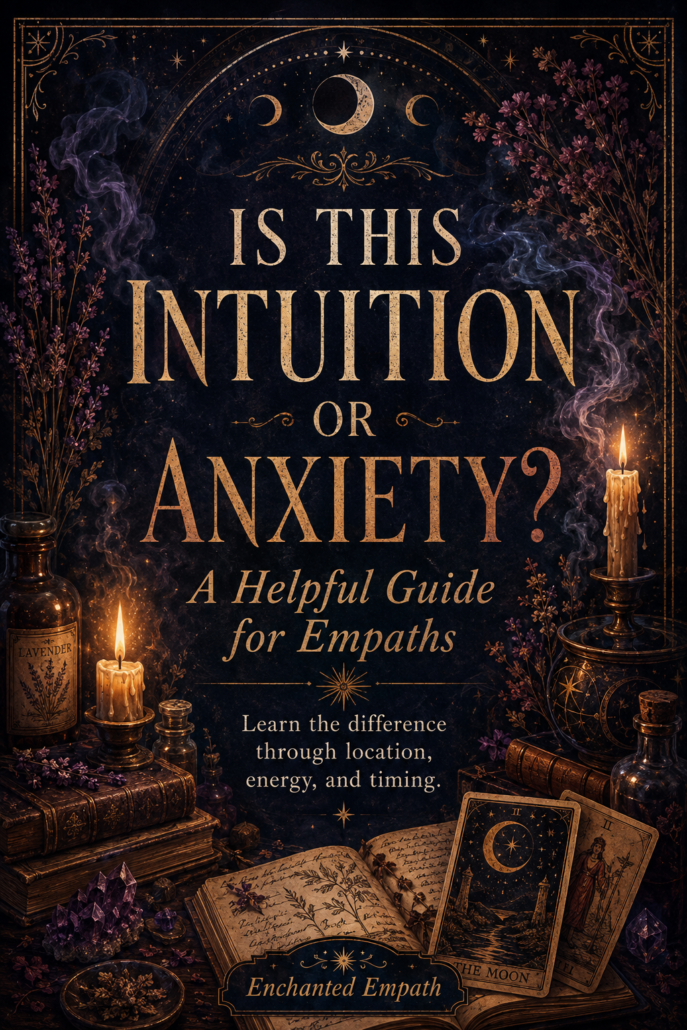
The Hanged Man is one of my favorite Tarot cards for understanding this process because his message is often misunderstood. He isn’t stuck. He is choosing not to move until he can see the situation differently. Instead of pushing forward simply because a decision needs to be made, he pauses, observes, and allows a new perspective to emerge.
That is an incredibly useful practice when you are trying to distinguish intuition from anxiety. Anxiety hates the space of not knowing. It wants an answer now so it can regain a sense of control. It may convince you that you need to make a decision, send the message, take the opportunity, end the relationship, or figure out what everything means immediately. The Hanged Man reminds us that sometimes the most powerful choice is to wait until the answer becomes clear.
I think of this as waiting for the aha. There is often a moment when something that has felt confusing suddenly settles into place. Your body relaxes, your perspective shifts, and what you need to do becomes obvious without all the mental wrestling. You may have been going back and forth for days, and then one morning you simply know. That clear feeling is very different from finally exhausting yourself into making a decision just so you can stop thinking about it.
The Hanged Man teaches us that clarity cannot always be rushed. Sometimes we need to stop trying to solve the situation and allow ourselves to hang there for a little while. Go live your life. Take a walk, sleep on it, pull back from the conversation, or simply admit that you do not know yet. You are not failing to make a decision. You are giving your intuition enough space to rise above the noise.
For empaths especially, this kind of pause can be powerful because we are often sorting through more than our own thoughts and feelings. When we stop reacting and give the energy time to settle, it becomes much easier to recognize what actually belongs to us. Then, when that quiet aha arrives, we can move from clarity rather than urgency. That is the wisdom of The Hanged Man: you do not always need to know what to do next. Sometimes you need to wait until you know.
Put the Three Clues Together
Now bring your original situation back to mind and look at it through these three lenses. Notice where you feel it in your body, what the quality of the energy feels like, and whether there was an immediate response before your thoughts started looping.
You are not looking for perfection. You are looking for patterns. If two or three of the clues point toward a quiet, steady knowing, it may be worth trusting that information. If everything feels activated, pressured, confused, or frantic, that may be a sign that you need more space before making a major decision.
Sometimes the most intuitive thing you can do is stop trying to figure everything out. Go for a walk, take a shower, sleep on it, journal, pull a Tarot card, or simply step away from the situation for a while. You do not have to wrestle clarity out of the Universe. Often, clarity arrives when we stop demanding it.
You Do Not Have to Chase Signs
This is another area where empaths can make psychic development much harder than it needs to be. You do not need to spend your day searching for signs or turning every little thing into a cosmic message. Spirit is always communicating, but that does not mean you have to become hypervigilant.
When we are desperately looking for confirmation, we can make almost anything mean what we want it to mean. When we are grounded, present, and receptive, meaningful synchronicities tend to stand out naturally. You notice them because they catch your attention, not because you are searching every license plate, feather, song lyric, dream, or repeating number for an answer.
Spirit will keep communicating. You do not have to force the conversation. Your job is simply to remain open enough to notice what genuinely resonates and grounded enough to discern the difference between a meaningful nudge and an anxious need for certainty.
From Sensitivity to Discernment
Becoming a confident intuitive is not about becoming more sensitive. Most empaths are sensitive enough already. It is about learning how to understand the sensitivity you already have.
Instead of feeling overwhelmed by every emotion or energetic shift, you begin asking better questions. Where do I feel this in my body? Does this feel pressured or clear? Did I know something before my mind became involved? Is this information, or am I caught in a story? As you continue practicing, sensitivity begins to turn into discernment, and discernment begins to build trust.
That is one of the central ideas behind Psychic School for Empaths. You do not need someone else to constantly interpret your experiences for you. You can learn how your own psychic senses work, understand your energetic responses, and develop a relationship with your intuition that becomes stronger through experience.
The next time you are wondering whether a feeling is intuition or anxiety, remember these three clues: location, energy, and timing. If those still do not give you a clear answer, remember The Hanged Man and give yourself permission to wait. Not knowing yet is not the same thing as being lost. Sometimes the clearest answer comes only after you stop pushing for one.
Use your own intuition with everything I have shared here. Pay attention to what resonates, experiment with it, and keep what proves true for you. Psychic development is not about becoming someone different. It is about recognizing the ways you are already connected, already receiving information, and already capable of knowing more than you think.