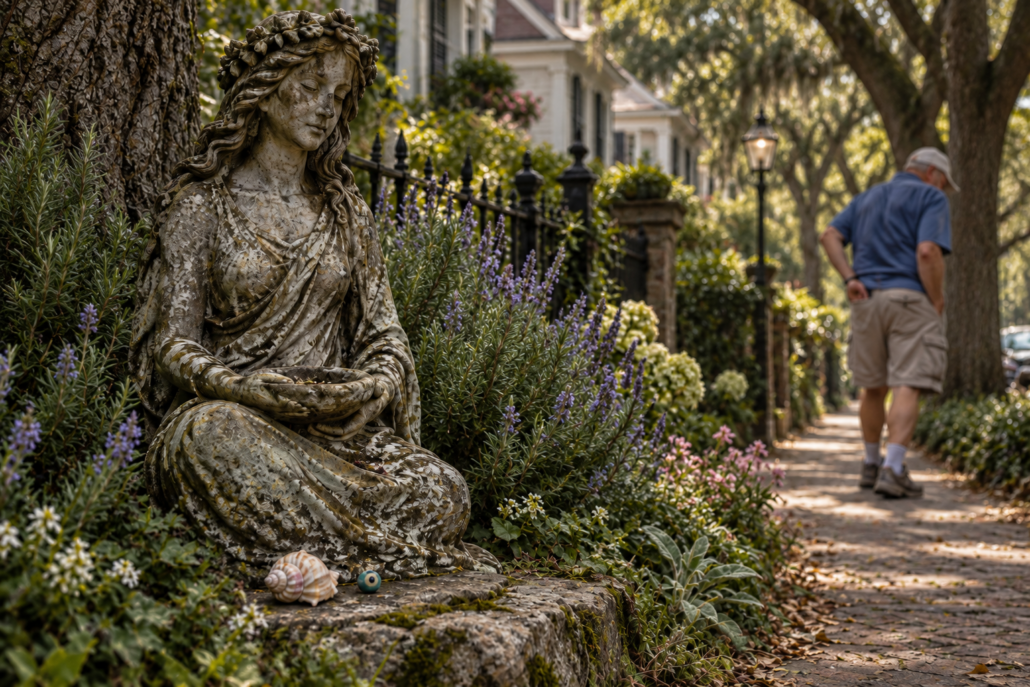
For months, there was a quarter sitting at the feet of the goddess in my front garden. Someone had left it there as an offering, along with a small seashell and a bead. I don’t know who placed them there or exactly when they appeared. That was part of the beauty of it. Someone had passed my little garden, seen the goddess standing there among the plants, and decided to leave something behind. Nothing expensive. Nothing grand. Just a quarter, a shell, and a bead, three tiny objects transformed into something sacred simply because they had been offered with intention.
They stayed there through weather, neighborhood activity, people walking past, tourists, dogs, deliveries, and all the ordinary movement of life. Month after month, nobody bothered them. Hundreds of people must have passed that statue and seen those little objects resting at her feet, and almost everyone seemed to understand something without needing a sign explaining it: these things were here for a reason, and they did not belong to them.
Then, about a week ago, I happened to be sitting at my desk looking out my office window when an older white man walked past my house. He looked like he could have been an Ashland tourist, wandering through the neighborhood and taking in the scenery. He stopped at my garden, looked down at the goddess, bent over, picked up the quarter, put it in his pocket, and kept walking.
I watched the entire thing happen, and I am still pissed off.
It Was Never About Twenty-Five Cents
Obviously, I am not upset because I lost a quarter. It wasn’t even my quarter, which is exactly the point. It wasn’t his either. Someone had deliberately placed that coin there with a seashell and a bead at the feet of a goddess statue. You did not need to be psychic to figure out that this was not loose change somebody had accidentally dropped on the sidewalk. You did not need to understand paganism, spirituality, offerings, altars, goddesses, or any other belief system. You simply needed the most basic awareness that another person had placed something somewhere intentionally.
And he took it anyway.
What keeps bothering me is the casualness of it. There was no visible hesitation, no pause, no apparent thought that perhaps this thing did not belong to him. He saw something he wanted, bent down, took it, and put it in his pocket. Maybe he thought nobody would care. Maybe he thought it was abandoned. Maybe his entire thought process was nothing more than, “Hey, a quarter.” I have no idea. What I do know is that I watched a grown man take something that clearly was not his simply because he could, and the symbolism of that tiny act has been sitting with me ever since.
Because if that isn’t America in twenty-five cents, I don’t know what is.
If I Can Take It, It Must Be Mine
There is an ancient sickness buried underneath so much of what we have been taught to call power. It is the belief that seeing something gives you the right to possess it, that wanting something gives you a claim to it, and that having enough money, strength, influence, weapons, status, or authority somehow transforms taking into ownership.
We have seen this mindset applied to land, money, resources, bodies, countries, cultures, labor, ideas, and anything else considered valuable enough to possess. The pattern is always familiar. Take it, claim it, rename it, fence it, buy it, drill it, develop it, grab it, put your name on it, and then act offended when someone suggests that perhaps it was never yours to begin with.
We dress this impulse up in respectable language. We call it exploration, expansion, acquisition, development, economic opportunity, national interest, growth, or manifest destiny. We find words that make taking sound noble, inevitable, or even righteous. But underneath all of that polished language is the same grubby little hand reaching toward the quarter and thinking, “I see it. I want it. Therefore, it belongs to me.”
No. It does not.
Iceland is not yours. Lake Ontario is not yours. The Gulf of Mexico does not become yours because you decide to rename it, and keep your greedy hands off of Albania. Other countries are not pieces of real estate waiting for a nepo baby or wealthy man to make an offer, and women and girls sure as hell are not yours for the “grabbing.” None of it becomes yours simply because you want it badly enough or because you have convinced yourself that power gives you permission.
The Old World Needs to Die
Before somebody deliberately misunderstands me, this is not about every older white man walking down the street. I know plenty of men who do not move through the world this way. I am talking about something much older and much bigger than the random man who walked past my house in Ashland. I am talking about a worldview that has been embedded in this country and much of Western civilization for centuries.
It is a crusty, exhausted, colonial worldview that equates ownership with success, domination with strength, accumulation with worth, and the ability to take something with the right to take it. It is a worldview built around the idea that the person who possesses the most wins, regardless of what had to be stolen, destroyed, conquered, exploited, or silenced along the way.
That worldview has given us colonization, stolen land, stolen labor, exploitation, corruption, environmental destruction, and generations of sexual violence excused or ignored because powerful men were considered more valuable than the people they harmed. It has given us fortunes built on other people’s suffering and industries that poison rivers because profit matters more than clean water. It has given us conquest disguised as patriotism, greed disguised as ambition, and domination disguised as leadership.
The faces at the top change from time to time, but the operating system remains remarkably familiar. Take what you can, protect what you own, accumulate more, and call it success.
I am ready for that way of being to die. Please die already.
I mean the worldview. I mean the system. I mean this rotten idea that humanity’s highest achievement is to control, possess, consume, and dominate everything within reach. I am tired of watching us drag this decomposing philosophy behind us and call it civilization, because there is nothing civilized about believing the entire world exists for your consumption.
The land is not here solely for you to extract from. Animals are not here solely for you to exploit. Women are not here for you to possess. Other cultures are not here for you to strip-mine for whatever you find useful or exotic. Other countries are not yours to threaten, buy, rename, invade, or absorb, and the tiny offerings at the feet of somebody else’s goddess are not yours either.
There Is Another Way to Be Human
What stays with me most about that quarter is not only that one man took it. It is that hundreds of other people must have walked past it and left it there. That matters just as much. For months, the offering survived because almost everyone who encountered it understood the simplest possible social contract: not mine.
There is tremendous hope in those two words. Not mine means I can admire something without owning it. I can encounter something without consuming it. I can walk beside it without conquering it. I can appreciate something without immediately wondering how I might profit from it. I can respect another person’s sacred space without needing to understand it or share their beliefs.
Maybe that is part of the new wave of humanity I am waiting for. I am not imagining some shiny spiritual fantasy in which everyone suddenly becomes enlightened and peaceful. I am talking about something much simpler and, in its own way, much more radical. I am talking about human beings who no longer equate power with possession and who understand that restraint is not weakness.
I want more people who know how to leave things alone, people who understand stewardship instead of ownership and relationship instead of domination. I want people who can experience beauty without immediately reaching for it, people who understand that having the ability to take something does not create the right to take it. I want a humanity mature enough to understand that power can also mean having an open hand.
Maybe the next evolution of humanity begins there. Maybe it begins with learning how to stop constantly closing our hands around whatever we can grab and learning instead how to stand in the presence of something beautiful, valuable, sacred, or simply not ours and allow it to remain exactly where it is.
Twenty-Five Cents
The shell is still there. The bead is still there. The quarter is gone. Twenty-five cents should be insignificant, but that quarter has become one of those strange little moments life hands you that somehow contains an entire philosophy.
I keep seeing that man bend down. I keep seeing his hand close around the coin and watching him slip it casually into his pocket before continuing down the street. The image sticks with me because so much of human history has followed exactly that same movement. See it, want it, take it, walk away, and leave someone else to deal with the consequences.
Maybe that is why I cannot forget something so small. I am ready for that story to end. I am ready for the age of grabbing to end. I am ready for the obsession with conquering, owning, accumulating, controlling, and dominating to become the embarrassing relic it should already be.
I am ready for something wiser and less afraid, something less greedy and more conscious of relationship. I am ready for a way of living that understands we do not have to possess everything we love, everything we value, or everything we encounter. The world does not belong to you, and it does not belong to me either.
Maybe our job was never to own it. Maybe our job was to recognize what is sacred, care for it while we are here, and, for once in our fucking lives, learn when to leave the quarter at the feet of the goddess.
Note to self: Keep the faith.