There is a particular kind of exhaustion that does not come from doing too much, but from carrying too much that was never yours to begin with. It shows up as a constant sense of responsibility, a feeling that everything depends on you, or that if you do not hold it all together, something will fall apart. It is a pattern I often see in empaths—taking on more than is theirs out of care, awareness, and a deep sensitivity to others.
On the surface, it can look like competence. You are reliable. Capable. The one people turn to. But underneath that is a quieter truth: you are tired in a way that rest does not seem to fix.
This is not simply about workload. It is about emotional, mental, and energetic responsibility that has slowly accumulated over time, often without being consciously chosen.
What’s Actually Happening Beneath the Surface
In many cases, this pattern begins with good intentions. You care. You want to help. You want things to work. You may have stepped in where others stepped back, or taken on more because it felt easier than watching something go undone.
Over time, however, this becomes a habit. You begin to anticipate what others need before they ask. You take responsibility for outcomes that are not fully within your control. You manage not only your own life, but the emotional landscape of those around you.
The difficulty is that this level of responsibility is rarely sustainable. It creates a constant low-level pressure that eventually turns into fatigue, resentment, or quiet burnout. And because you are so accustomed to carrying it, it can be difficult to recognize where your responsibility ends and someone else’s begins.
The Tarot Pattern: Ten of Wands Energy
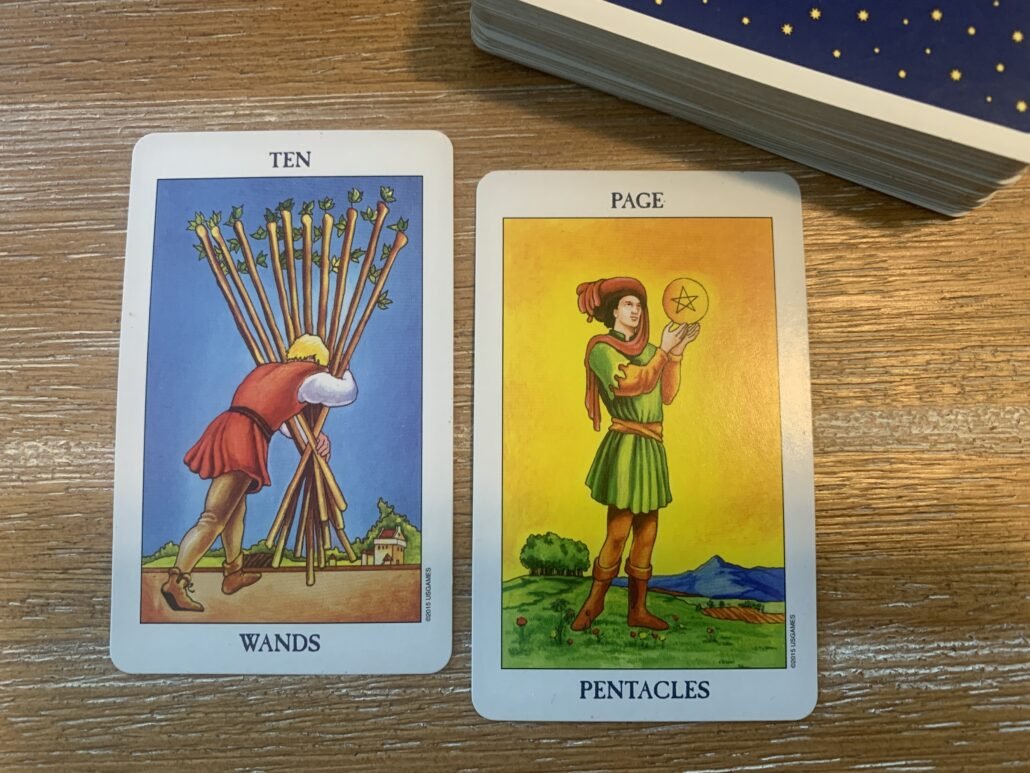
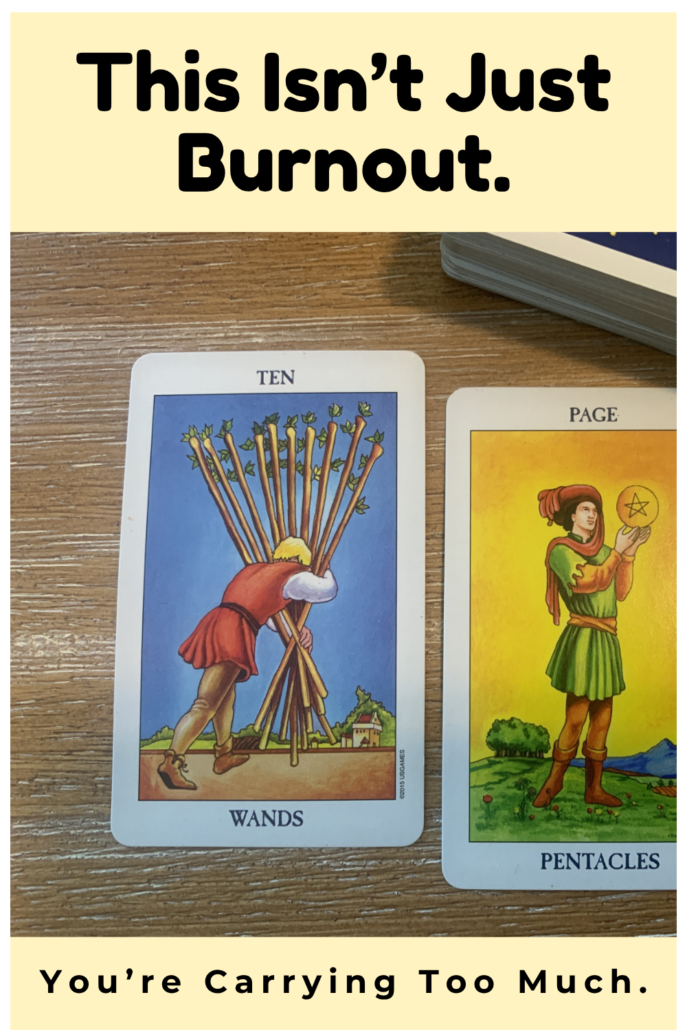
The Ten of Wands captures this state with striking clarity. It is the image of someone burdened, carrying more than is reasonable, pushing forward under the weight of accumulated obligations. It is often associated with hard work, but more accurately, it reflects overextension.
This card does not suggest that you are incapable. Quite the opposite. It suggests that you have proven your capability to the point where you continue to take on more, whether it is necessary or not.
The weight in the Ten of Wands is not always imposed from the outside. Much of it is self-assumed. It comes from an internal belief that you must handle everything, that it is your role to ensure things are managed, stabilized, or resolved.
Over time, this creates a life that feels heavier than it needs to be.
The Shift: Page of Pentacles Simplicity
The movement out of this pattern is represented by the Page of Pentacles. Where the Ten of Wands is burdened and overextended, the Page is focused, grounded, and intentional. He is not trying to carry everything. He is engaged with what is directly in front of him, what is tangible, real, and his to work with.
This is a return to simplicity. Not in the sense of doing less for the sake of doing less, but in the sense of doing what is actually yours to do, and no more.
The Page of Pentacles asks you to come back to your own life, your own responsibilities, your own growth. It invites you to place your energy where it is effective, rather than where it is habitual.
This shift is not dramatic, but it is powerful. It is the difference between carrying everything and choosing carefully.
A Literary Reflection on Carrying Too Much
In The Fountainhead, Ayn Rand writes, “I do not recognize anyone’s right to one minute of my life.” While stark, the sentiment points to something essential: the recognition that your time, energy, and effort are not automatically owed simply because you are capable of giving them.
When you begin to see your energy as something to be directed rather than distributed, your relationship to responsibility changes.
How to Return to What Is Yours
If you recognize yourself in this pattern, the first step is not to drop everything at once. It is time to begin noticing.
Where are you overextending?
Where are you taking responsibility for something that does not fully belong to you?
Where are you stepping in out of habit rather than necessity?
From there, the work becomes more precise. It is not about withdrawing completely, but about recalibrating. You begin to ask, “Is this mine to carry?” and allow that question to guide your choices.
In many cases, you will find that what feels urgent is not always essential, and what feels heavy is not always yours.
The Strength in Letting Go
There is a quiet strength in releasing what is not yours. It does not make you less reliable or less capable. It makes you more aligned.
When you are no longer carrying everything, you have the capacity to engage more fully with what truly matters. Your energy becomes clearer, more focused, and more effective.
You are not here to hold everything together. You are here to tend to what is yours. And when you do, the weight begins to lift, and you’ll be able to lift your head again to notice the beauty and lightness that surrounds you.