There is a moment I see often in readings, and you may recognize it in yourself. Someone comes in saying they feel confused. They have been going back and forth, thinking about the situation from every angle. They have asked for signs, pulled cards, journaled, talked it out, and still feel no closer to clarity. They describe themselves as stuck, uncertain, or overwhelmed by options.
But when we slow the situation down and look at it carefully, something else becomes clear. They are not confused. They already know. They are simply not ready to choose.
Confusion vs. Avoidance: An Important Distinction
This is an important distinction, because confusion and avoidance require very different kinds of attention. Confusion feels passive, as though clarity is something that will eventually arrive if you think long enough or gather enough information. Avoidance, however, is active. It is the quiet, often unconscious decision to remain where you are because the next step carries consequence, discomfort, or change.
What “Confusion” Usually Really Is
In my work, what people call confusion is usually one of three things.
The first is a fear of consequence. You may already know what the right decision is, but you also understand what comes with it. If you leave, something ends. If you stay, something continues that no longer feels aligned. If you speak honestly, a dynamic may shift in ways you cannot control. So instead of deciding, you remain in analysis. Not because you do not know, but because you do.
The second is a belief that clarity should feel certain. Many people expect intuition to arrive as a clean, confident, unmistakable answer. In reality, intuition is often quieter and more grounded. It does not always feel dramatic or absolute. It feels simple, steady, and easy to overlook. Because it lacks intensity, it is often dismissed in favor of continued searching.
The third is the tendency to outsource authority. This is where tools like Tarot, advice from others, or repeated conversations can become part of a loop. You check again. You ask again. You look for confirmation that will make the decision feel safer. However, no amount of external clarity can replace an internal choice. At some point, you must decide, not because you have perfect certainty, but because you trust yourself enough to move forward.
The Tarot Pattern: Seven of Cups Energy
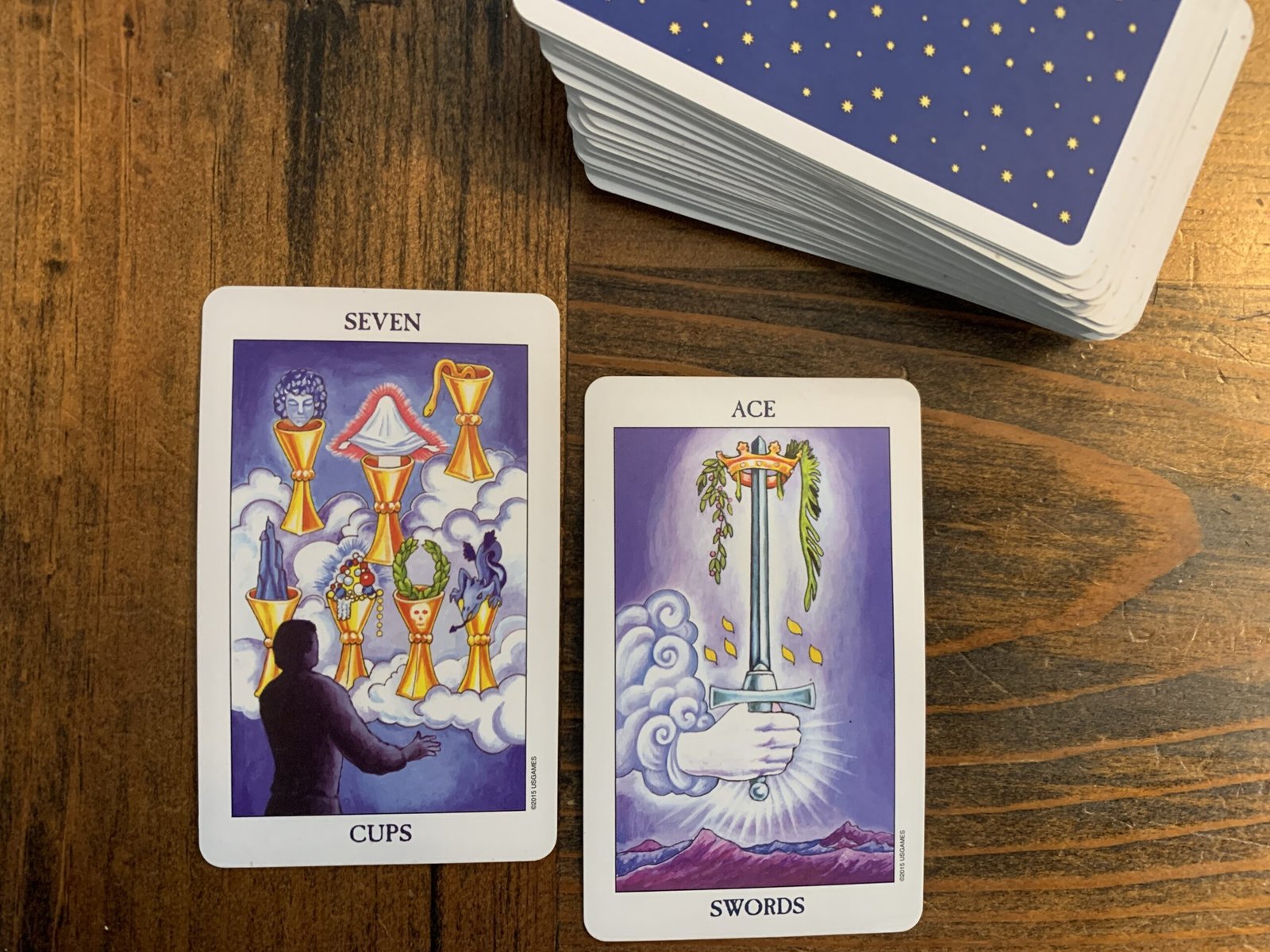
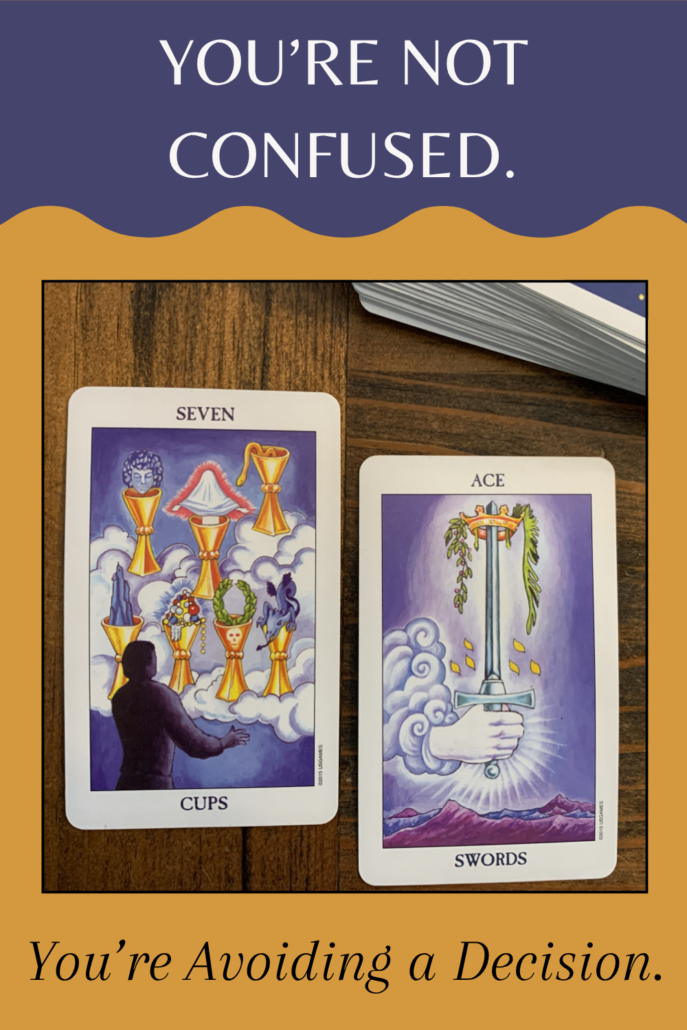
There is a Tarot combination that illustrates this pattern with remarkable precision. The Seven of Cups is often labeled as a card of confusion, but this is somewhat misleading. It is not confusion in the sense of having no idea what to do. It is the experience of having too many options, too many imagined outcomes, and too much emotional and mental noise. It reflects a state of circling, considering, imagining, weighing possibilities, all without arriving at a grounded decision.
I often refer to this as a kind of Hamlet syndrome, “he who hesitates is lost.” It captures the essence of this energy perfectly: not a lack of knowing, but a prolonged hesitation that slowly pulls you away from what you already sense is true.
The Shift to Clarity: Ace of Swords
The Ace of Swords represents the shift out of this energy. This card is commonly associated with clarity, but it is important to understand that it does not simply arrive as a gift. The Ace of Swords is the moment you tell yourself the truth. It is direct, clean, and often uncomplicated. It cuts through the layers of overthinking and brings you back to what is actually happening. From there, a decision becomes possible, not because everything feels perfect, but because something feels true enough to act on.
How to Move from Confused to Decisive
This is the real movement from confusion to clarity. It is not the result of gathering more information or waiting for a stronger sign. It is the result of honesty followed by choice.
If you find yourself in this space, it can be helpful to ask a different kind of question. Instead of asking, “What should I do?” try asking, “If I had to choose today, what would I choose?” Not what feels easiest or least disruptive, but what feels true. You do not have to act immediately, but you do need to acknowledge the answer.
It is also worth asking what you are hoping will happen if you do not decide. Many people unconsciously hope that time will resolve the situation, that something external will shift, or that clarity will eventually arrive without requiring action. In reality, indecision is its own form of decision-making. It keeps you in the same place, reinforcing the very feeling of being stuck.
You’re Standing at a Threshold
You are not confused. You are standing at a threshold. And thresholds are not meant to be analyzed indefinitely. They are meant to be crossed.
Podcast: Play in new window
Want more? Subscribe. Apple Podcasts | RSS